Athletic scheduling has quietly become one of the most complex operational data problems inside K–12 environments.
Multiple schools. Multiple sports. Multiple scheduling sources. Multiple systems. Constant change.
Yet most districts still rely on:
- Manual spreadsheets
- Fragile uploads
- Siloed platforms
- Human reconciliation
This introduces systemic risk.
Modern athletic scheduling infrastructure provides AI-assisted data processing designed for data quality, governance, and operational resilience.
The Core Problem: Scheduling Is a Distributed Data Integrity Challenge
Athletic scheduling systems ingest data from multiple untrusted sources:
| Source Type | Common Issues |
|---|---|
| League files | Inconsistent formatting, missing metadata |
| State association documents | PDF-based, unstructured data |
| Coach-maintained spreadsheets | Duplicate entries, outdated records |
| Web-scraped schedules | Fragile extraction, schema drift |
| Legacy exports | Non-standard formats, encoding issues |
Each source carries inconsistencies, duplication, and ambiguity.
Traditional systems treat these as input problems. Modern infrastructure treats them as data engineering challenges.
Built for Real-World Data Chaos
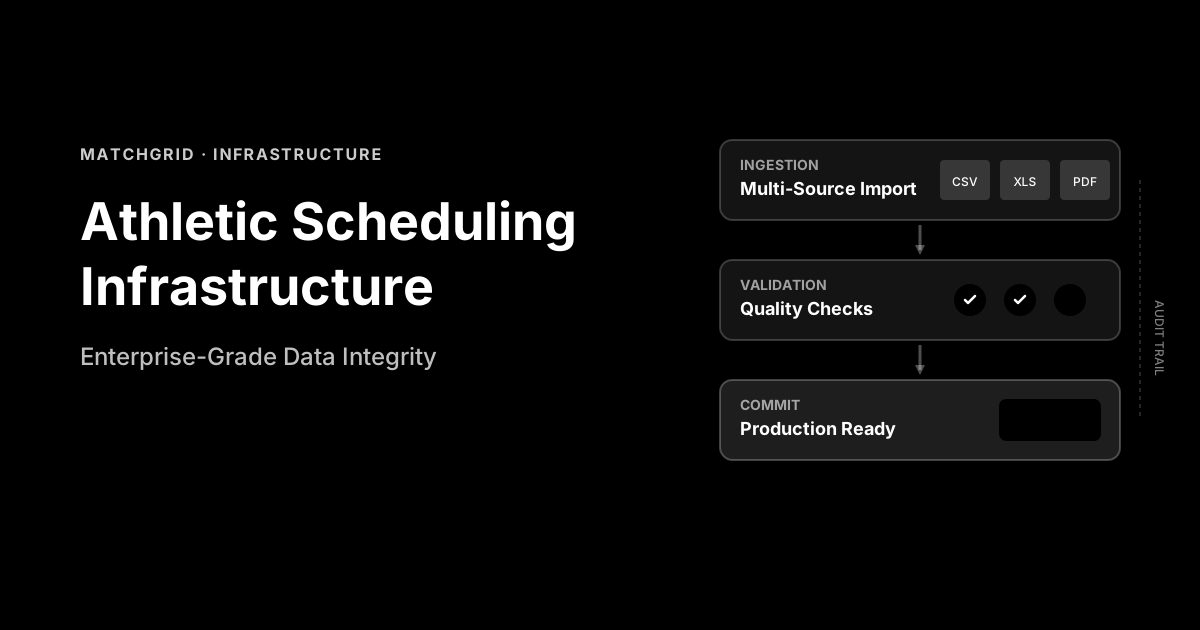
Enterprise-grade scheduling infrastructure applies a structured ingestion pipeline that:
Stage 1: Extraction
- Accepts arbitrary file formats (CSV, Excel, PDF, Word, images)
- Extracts entities and relationships using AI-assisted parsing
- Preserves original source data for audit trails
Stage 2: Normalization
- Standardizes naming conventions across sources
- Classifies entities (schools, teams, venues, contacts)
- Detects and merges duplicates using fuzzy matching
- Flags conflicts and ambiguities for human review
Stage 3: Quality Scoring
- Validates completeness (missing required fields)
- Checks referential integrity (broken relationships)
- Measures confidence scores for extracted data
- Generates quality reports before commit
Stage 4: Staging
- Isolates unvalidated data from production systems
- Provides human-in-the-loop approval workflows
- Supports rollback and version control
- Maintains full lineage tracking
This architecture prevents:
- Silent corruption
- Duplicate records
- Cascading scheduling errors
- Downstream operational failures
Security, Compliance, and Governance
Designed to align with enterprise expectations for K–12 systems:
Tenant Isolation
Strict multi-tenancy boundaries ensure:
- Schools cannot access other schools’ data
- Districts maintain hierarchical access controls
- Data sovereignty at the district level
Role-Based Access Controls
Granular permissions for:
- District administrators
- School athletic directors
- Coaches (view-only or limited edit)
- IT staff (system administration)
Audit Logging
Complete audit trails for compliance:
- Every data change tracked with timestamp and user
- Source provenance for all imported records
- Full diff history for schedule modifications
- Export capabilities for compliance reporting
Non-Destructive Workflows
No black-box imports:
- Staging environments for all data changes
- Human approval gates before production commit
- Reversible operations with rollback support
- Dry-run capabilities for impact analysis
Operational Impact for IT Leadership
Reduced System Fragility
Eliminates fragile import scripts and ad-hoc transformations that break with minor format changes. Centralized ingestion pipeline handles schema variations automatically.
Lower Support Burden
Reduces manual cleanup requests, escalation loops, and emergency fixes. Self-service validation tools let athletic staff resolve data issues without IT intervention.
Better Reliability at Scale
Handles multi-school, multi-sport scheduling without data drift. Consistent data models across schools prevent integration failures.
Stronger Governance
Every change is traceable, reversible, and auditable. Compliance teams can reconstruct data lineage for any scheduling decision.
Designed for District-Scale Complexity
Enterprise scheduling infrastructure supports:
Multi-School Hierarchies
- District-level scheduling coordination
- School-level autonomy with district oversight
- Shared resource management across buildings
- Cross-school scheduling for small programs
Shared Facility Scheduling
- Venue conflict detection across schools
- Capacity management for district facilities
- Priority rules for facility allocation
- Real-time availability tracking
Regional League Structures
- Multi-district league scheduling
- Conference and division management
- Automated schedule distribution to member schools
- Conflict resolution across organizational boundaries
Multi-Season Planning
- Continuous scheduling across sports seasons
- Resource planning for overlapping programs
- Historical data retention for trend analysis
- Predictive modeling for future seasons
Continuous Change Management
- Real-time schedule updates without full regeneration
- Impact analysis for proposed changes
- Automated notification to affected stakeholders
- Version control for schedule iterations
Technical Architecture Principles
Modern scheduling infrastructure follows enterprise systems patterns:
Immutable Event Sourcing
- All changes stored as events, never destructive updates
- Full history reconstruction for any point in time
- Simplified debugging and troubleshooting
Idempotent Operations
- Safe retry logic for import operations
- Prevents duplicate data creation on network failures
- Consistent state regardless of retry count
Schema Validation
- Strict type checking for all imported data
- Validation against defined constraints
- Early failure detection before persistence
API-First Design
- RESTful interfaces for integration
- Webhook support for event notifications
- Bulk operation capabilities for large datasets
- Rate limiting and throttling for stability
Integration with District Systems
Modern scheduling platforms integrate with existing infrastructure:
Student Information Systems (SIS)
- Roster synchronization
- Eligibility verification
- Parent contact information
Identity Management
- SSO via SAML or OAuth
- Active Directory integration
- Role provisioning from directory services
Communication Platforms
- Schedule publishing to district websites
- Email notifications via SMTP
- Calendar integration (Google, Outlook)
Analytics Platforms
- Export to business intelligence tools
- Custom reporting via SQL access
- Real-time dashboards for operations teams
Cost of Ownership Considerations
Infrastructure decisions require total cost analysis:
Reduced Manual Labor
Automated data processing eliminates:
- Hours of spreadsheet cleanup per season
- Emergency fixes for scheduling conflicts
- Manual duplicate detection
- Ad-hoc data reconciliation
Fewer System Failures
Predictable operations reduce:
- Emergency support requests
- After-hours incident response
- Data corruption recovery
- Schedule republishing due to errors
Institutional Memory
Centralized systems preserve knowledge:
- Historical scheduling patterns
- Validated venue and team data
- Tested constraint configurations
- Reusable templates for future seasons
Scheduling Is Now an Infrastructure Problem—Treat It Like One
When schedules fail, systems take the blame.
Districts cannot afford fragile scheduling operations. Athletic scheduling infrastructure should meet the same standards as student information systems, learning management platforms, and financial systems.
Modern scheduling infrastructure provides:
- Reliable data pipelines
- Traceable operations
- Security by design
- Scalable architecture
- Predictable costs
Athletic scheduling is no longer a spreadsheet problem. It is a data engineering challenge that requires appropriate infrastructure.
Ready for a technical deep dive? Modern platforms like MatchGrid provide enterprise-grade scheduling infrastructure with full audit trails, tenant isolation, and data quality pipelines. Explore MatchGrid →
Frequently Asked Questions
How does athletic scheduling infrastructure handle FERPA compliance?
Modern platforms implement strict access controls, audit logging, and data minimization principles. Student personally identifiable information (PII) is segregated from scheduling data. Role-based access ensures only authorized personnel access sensitive records. Full audit trails document every data access for compliance reporting.
What is the disaster recovery strategy for scheduling systems?
Enterprise platforms use immutable event sourcing with point-in-time recovery. All changes are stored as events, allowing reconstruction to any historical state. Backups include both database snapshots and event logs. Recovery time objectives (RTO) typically under 1 hour for critical scheduling operations.
Can scheduling infrastructure integrate with our existing SIS?
Yes. Modern platforms provide API-first architecture with connectors for major SIS vendors (PowerSchool, Infinite Campus, Skyward). Integration patterns include roster synchronization, eligibility verification, and contact information updates. Webhooks enable real-time notifications for schedule changes.
How does the platform handle data quality for imported files?
Import pipelines use multi-stage validation: (1) schema validation for format correctness, (2) duplicate detection using fuzzy matching, (3) referential integrity checks for broken relationships, (4) completeness scoring for missing fields. All issues flagged for human review before production commit. Original files preserved for audit trails.
What is the performance impact of AI-assisted data processing?
AI extraction runs asynchronously, not blocking user operations. Typical processing time for league schedules: 30-90 seconds. Large district imports (100+ schools): under 5 minutes. Users receive notifications when processing completes. System scales horizontally for concurrent import operations.
How are multi-tenant security boundaries enforced?
Tenant isolation implemented at database level using row-level security (RLS). Every query automatically filtered by tenant context. No shared data between districts. API requests validated against tenant membership before data access. Penetration testing verifies isolation guarantees.
What happens during schema changes or system upgrades?
Platform uses blue-green deployment for zero-downtime upgrades. Database migrations run in transaction-safe batches. Schema changes backward-compatible for rolling updates. Districts schedule maintenance windows for major version upgrades. Full regression testing before production deployment.
Build on Resilient Infrastructure
Athletic scheduling infrastructure built for enterprise-grade data integrity doesn’t just manage calendars. It provides reliable data pipelines, traceable operations, and security-by-design architecture that meets K–12 district standards.
If you lead technology strategy for schools or districts, the right infrastructure eliminates operational risk while reducing support burden.