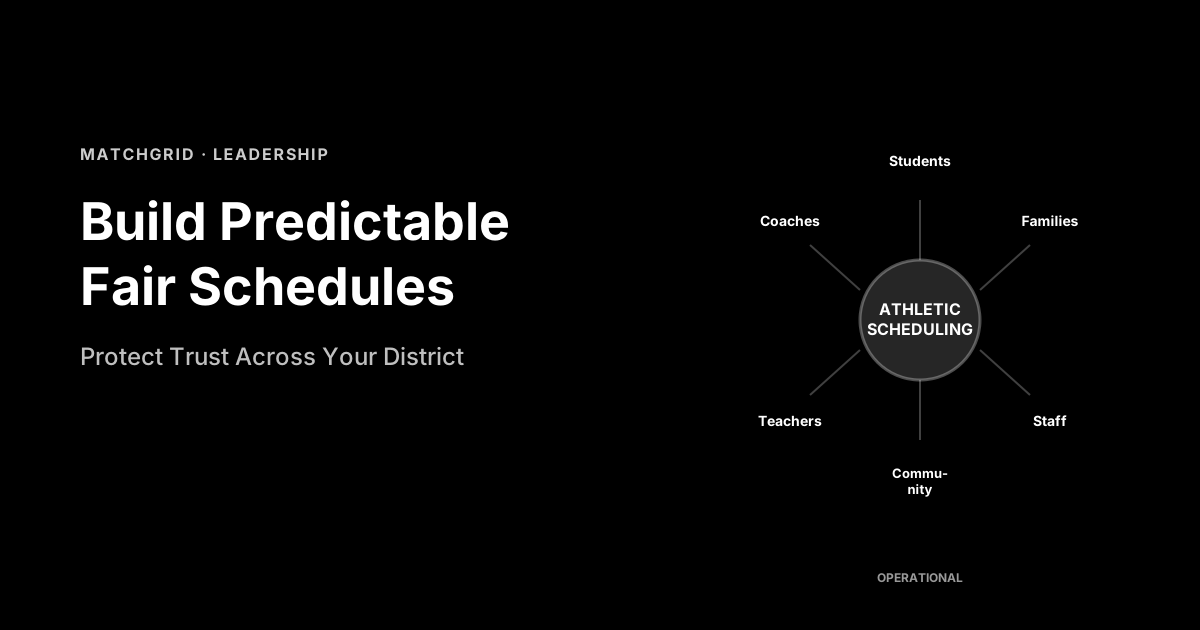
Athletics touches everyone in your district: students, families, teachers, coaches, administrators, and communities.
When scheduling breaks, everyone feels it.
Late changes. Double bookings. Travel confusion. Cancelled games.
These are not technical problems. They are leadership problems.
Effective athletic scheduling helps districts build predictable, fair, and resilient schedules that protect operational trust.
The Challenge: Athletic Scheduling Is a Systemic Coordination Problem
District leaders balance competing demands across:
| Stakeholder | Core Needs |
|---|---|
| Multiple schools | Fair distribution of prime time slots |
| Multiple sports | Overlapping seasons, shared resources |
| Shared facilities | Competing priorities for gyms, fields, pools |
| Limited resources | Transportation, officials, staffing |
| Competing priorities | Academics, events, community use |
One scheduling error can ripple across:
- Transportation – Last-minute route changes, driver overtime
- Academics – Class disruptions, missed instruction
- Families – Childcare conflicts, work schedule impacts
- Community relations – Lost trust, escalated complaints
Effective scheduling prevents those ripples before they begin.
What Changes When Scheduling Works
For Students
More consistent schedules – Students can plan academic commitments, work schedules, and family obligations around predictable game times.
Fewer disruptions – Reduced last-minute changes mean fewer missed classes and less academic impact.
Fairer competition – Balanced schedules prevent advantages from favorable time slots or travel burdens.
For Families
Fewer last-minute changes – Parents can coordinate childcare, work schedules, and family commitments with confidence.
Clear expectations – Transparent scheduling processes reduce confusion and complaints.
Higher trust – Consistent operations demonstrate district competence and respect for family time.
For Staff
Less manual coordination – Athletic directors and administrators spend less time fixing problems, more time supporting programs.
Fewer emergencies – Proactive conflict detection prevents late-night calls and weekend firefighting.
More time for students – Staff focus shifts from operational crises to student development and program quality.
Why Modern Scheduling Infrastructure Is Different
Traditional scheduling tools rush to build calendars. Modern scheduling infrastructure focuses on decision quality before execution.
The Quality-First Approach
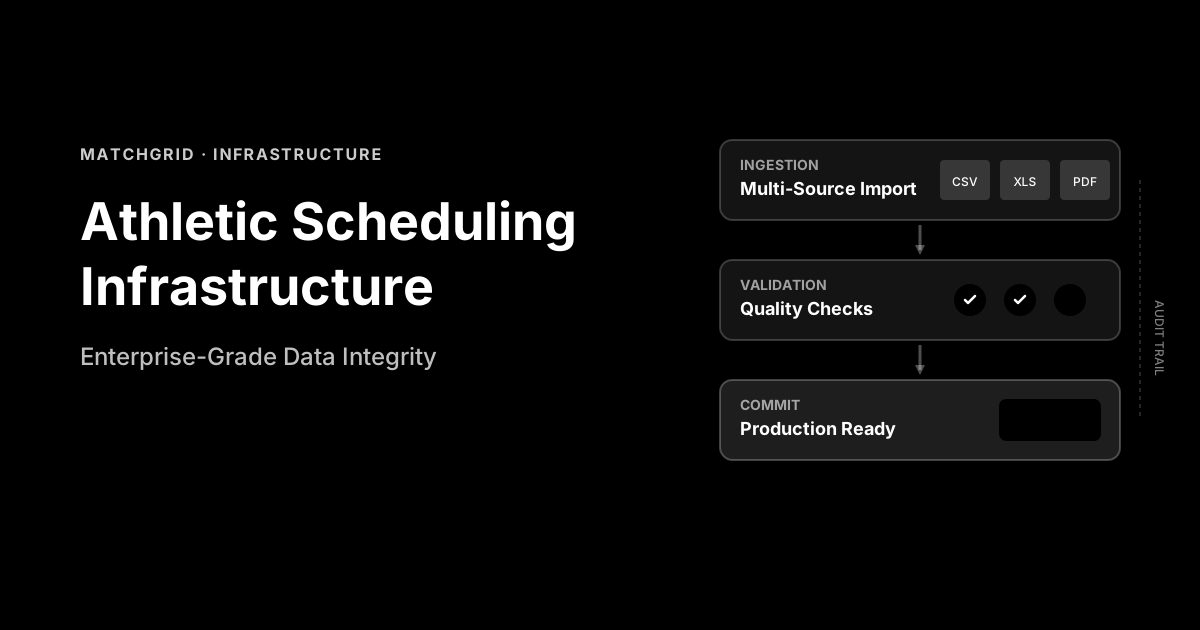
Instead of immediately generating schedules, the system:
- Cleans data – Removes duplicates, standardizes naming, validates completeness
- Detects conflicts – Identifies double bookings, travel issues, fairness violations
- Flags risks – Highlights potential problems before schedules go public
- Requires human validation – Ensures leadership maintains final approval authority
This prevents breakdowns before they reach students and families.
The Leadership Value
District leaders need confidence that operations will not create escalations. Modern scheduling infrastructure provides:
- Predictability – Schedules built on validated data with clear constraints
- Transparency – Full audit trails show how decisions were made
- Accountability – Clear ownership and approval workflows
- Resilience – Systems that handle changes without cascading failures
District-Level Outcomes
Operational Metrics
Effective scheduling systems deliver measurable improvements:
- Fewer schedule-related complaints – Reduction in parent and coach escalations
- Fewer last-minute changes – Schedules stay stable through the season
- Higher completion rates – More games played as scheduled without rescheduling
- Faster resolution – Conflicts resolved in hours instead of days
Strategic Benefits
Beyond operational efficiency, strong scheduling delivers leadership outcomes:
Stronger operational confidence – Principals and athletic directors trust the system works.
Higher community trust – Families see competence in critical operations.
Better resource utilization – Facilities, transportation, and staff used efficiently.
Reduced administrative burden – Less time on reactive fixes, more on proactive improvement.
The Hidden Cost of Poor Scheduling
Scheduling failures create cascading costs that rarely appear in budgets:
Direct Costs
- Transportation rework for changed game times
- Overtime for staff managing emergency fixes
- Event cancellations affecting gate revenue
- Official reassignments and penalties
Indirect Costs
- Administrative time responding to complaints
- Principal time managing parent escalations
- Lost instructional time from schedule disruptions
- Reputational damage affecting district perception
Leadership-grade scheduling infrastructure eliminates these costs by preventing problems upstream.
Building Institutional Capacity
Districts that invest in scheduling infrastructure build long-term capacity:
Institutional Memory
Systems preserve knowledge across leadership transitions:
- Historical scheduling patterns and constraints
- Validated facility and team configurations
- Tested policies and decision frameworks
- Reusable templates for future seasons
Process Standardization
Consistent operations across schools:
- Uniform data collection methods
- Shared conflict resolution procedures
- Standard communication protocols
- Aligned fairness expectations
Continuous Improvement
Data-driven refinement over time:
- Track scheduling metrics across seasons
- Identify recurring problem patterns
- Test process improvements systematically
- Share best practices across schools
Multi-School Coordination Challenges
District scheduling differs fundamentally from single-school operations:
Equity Concerns
Fair distribution of resources – Prime time slots, favorable venues, travel burdens must balance across schools.
Competitive balance – Schedules should not systematically advantage or disadvantage specific schools.
Opportunity equality – All schools deserve consistent scheduling quality regardless of size or program maturity.
Operational Complexity
Shared facilities – Multiple schools competing for limited gym, field, and pool capacity.
Transportation coordination – District vehicles serving multiple schools with overlapping schedules.
Cross-district competition – Schedules involving schools from multiple districts require coordination beyond your control.
Multi-level programs – Varsity, JV, and freshman schedules interconnected by facility and staff constraints.
Leadership Is About Stability
Athletics should feel:
- Predictable – Families and staff trust schedules will hold
- Fair – All schools and teams treated equitably
- Transparent – Decision processes clear and consistent
- Professional – Operations reflect district standards
Modern scheduling infrastructure helps deliver that experience.
Related guides:
- Build Fair Schedules Teams Can Trust – Fairness principles and metrics
See how districts build operational trust – Modern platforms like MatchGrid provide decision-quality scheduling that protects community trust across complex multi-school environments. Explore MatchGrid →
Frequently Asked Questions
How does athletic scheduling impact district reputation?
Scheduling operations are highly visible to families and communities. Frequent changes, perceived unfairness, or chaotic communications damage trust in district leadership. Conversely, predictable and fair scheduling demonstrates operational competence, builds confidence in administration, and protects district reputation during critical enrollment periods.
What is the superintendent’s role in athletic scheduling?
Superintendents set policy expectations for fairness, equity, and operational quality. While athletic directors execute scheduling, superintendents ensure systems and processes align with district values. Key responsibilities include: approving scheduling policies, reviewing equity metrics across schools, and ensuring adequate resources for sustainable operations.
How should districts balance competitive athletics with academic priorities?
Start with non-negotiable academic constraints: no games during major testing, limits on early dismissals, caps on weekly game commitments per student. Build schedules that respect instructional time while maintaining competitive opportunities. Track academic impact metrics (missed class time, grade trends for athletes) to ensure athletics supports rather than undermines educational mission.
What scheduling metrics should district leaders monitor?
Track operational health indicators: schedule change rate after publication, complaint volume by school and sport, average resolution time for conflicts, facility utilization rates, transportation cost per event. Also monitor equity metrics: time slot distribution across schools, travel burden balance, home game parity. Use these to identify systemic issues requiring policy intervention.
How do you handle scheduling conflicts between schools in the same district?
Establish clear priority hierarchies before conflicts arise: academic events over athletics, varsity over sub-varsity, district tournaments over regular season. Create conflict resolution protocols with defined escalation paths. Use scheduling systems that detect conflicts early and propose alternatives based on district policies. Document decisions to maintain consistency across similar situations.
What happens when a scheduling decision creates community backlash?
Transparent processes prevent most backlash. When it occurs: (1) Acknowledge the concern promptly, (2) Explain the decision criteria and constraints, (3) Show how the decision aligns with district policy, (4) Offer appropriate remedies if policy was misapplied. If backlash reveals policy problems, engage stakeholders to refine the policy before next season. Consistency and fairness matter more than perfect decisions.
How often should districts update athletic scheduling policies?
Review annually before season planning begins. Update policies when: new schools join the district, facility capacity changes significantly, transportation constraints shift, or recurring conflicts reveal policy gaps. Involve athletic directors, principals, and coach representatives in policy review. Communicate changes before scheduling begins to prevent surprises.
Lead With Operational Excellence
Athletic scheduling that protects district trust requires more than calendar management. It demands data quality, conflict prevention, fairness enforcement, and transparent processes that demonstrate operational competence.
Districts that build leadership-grade scheduling infrastructure eliminate operational chaos while strengthening community confidence in district administration.