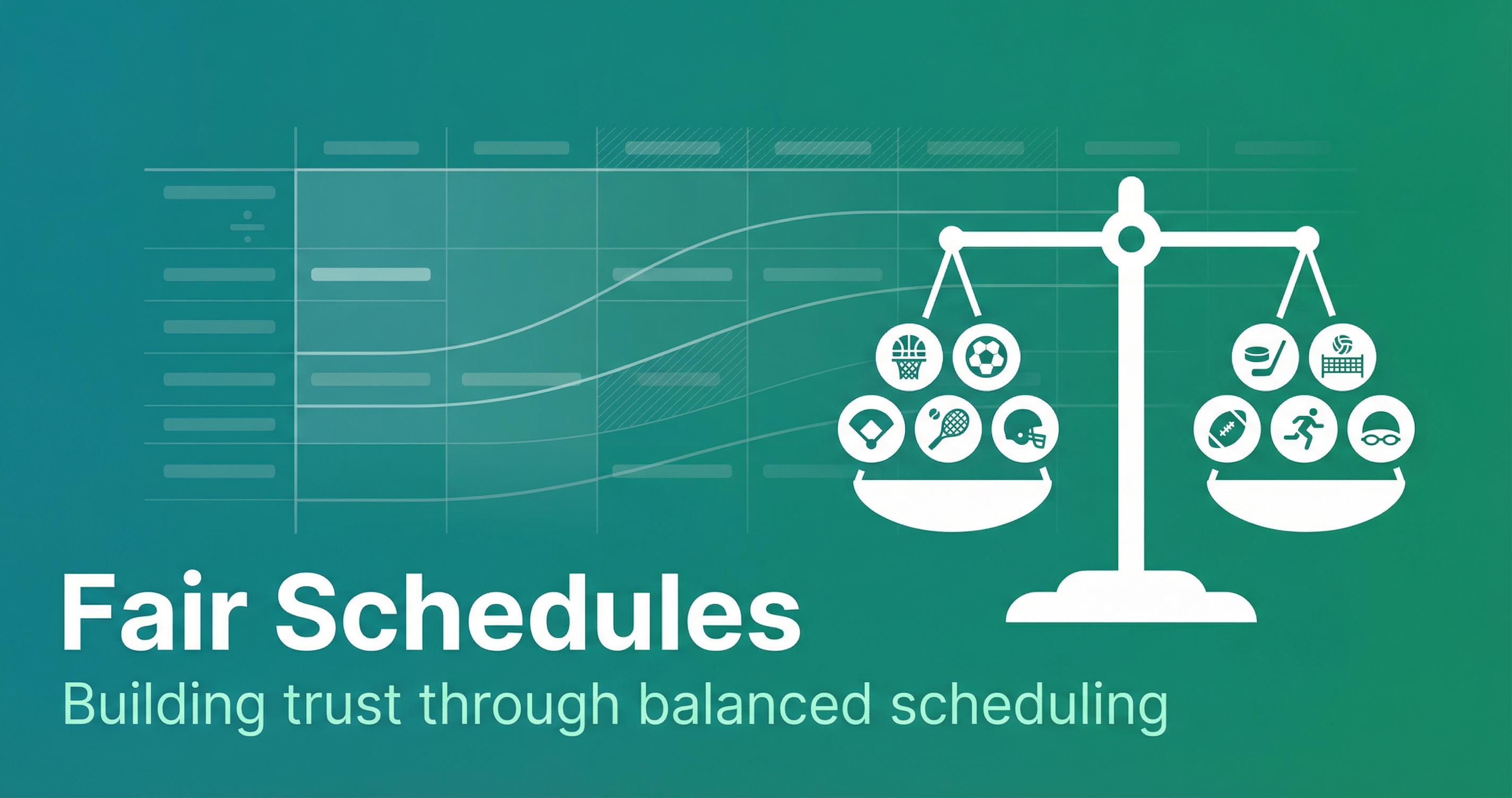
Trust is the currency of league administration. When teams trust the schedule is fair, they focus on playing. When they don’t, every loss becomes a grievance about unfair treatment. This guide explains what fairness actually means in scheduling—not philosophically, but operationally.
What “Fair” Actually Means
Fairness in scheduling isn’t about making everyone happy. It’s about ensuring no team has a systematic advantage or disadvantage compared to others.
The Four Pillars of Schedule Fairness
| Pillar | What It Measures | Why It Matters |
|---|---|---|
| Home/Away Balance | Equal home and away games | Home court advantage is real |
| Rest Equity | Similar rest between games | Fatigue affects performance |
| Travel Burden | Comparable travel distances | Time and cost impact teams |
| Opponent Timing | When you face strong/weak teams | Early vs. late matchups differ |
A fair schedule balances all four. Optimizing one often hurts another.
Home/Away Balance
Home court advantage is statistically significant across all sports. Teams playing more home games have a measurable edge.
The Target
- Ideal: Equal home and away games (e.g., 7 home, 7 away in a 14-game season)
- Acceptable: Difference of 1 game maximum
- Problem: Difference of 2+ games
Why Perfect Balance Is Hard
With an odd number of teams, someone always has an imbalance. With venue constraints, some teams can’t host certain weeks. The math doesn’t always work.
How to Measure
Calculate for each team:
Home/Away Differential = Home Games - Away GamesYour league’s range should be tight:
- Good: All teams between -1 and +1
- Acceptable: All teams between -2 and +2
- Needs work: Any team outside -2 to +2
Compensation Strategies
When perfect balance isn’t possible:
- Rotate year-to-year: Team with +1 this year gets -1 next year
- Balance within division: Prioritize balance against direct competitors
- Document and communicate: Transparency builds trust even when balance isn’t perfect
Rest Days and Back-to-Backs
Fatigue is a competitive factor. A team playing their third game in four days faces a rested opponent at a disadvantage.
Rest Day Standards
| Scenario | Minimum Rest | Ideal Rest |
|---|---|---|
| Single game week | N/A | N/A |
| Two games same week | 2 days | 3+ days |
| Back-to-back days | Avoid if possible | Never for youth |
| After long travel | Extra day | Two days |
Back-to-Back Rules
Never acceptable:
- Youth leagues (safety concern)
- After games ending past 9 PM
- When combined with significant travel
Sometimes acceptable:
- Adult recreational leagues
- Tournament settings with all teams affected equally
- When teams opt in explicitly
Measuring Rest Equity
Track minimum rest days for each team across the season:
Team A: 3, 4, 3, 5, 2, 4, 3 (min: 2 days)
Team B: 4, 3, 4, 3, 4, 3, 4 (min: 3 days)
Team C: 2, 2, 3, 4, 2, 3, 2 (min: 2 days, but three 2-day rests)
Team C has a harder schedule than Team B, even with the same minimum.
The Rest Fairness Score
Count instances of minimum rest (2 days or less) per team. The range across your league should be narrow:
- Good: All teams within 1 instance of each other
- Acceptable: Within 2 instances
- Needs work: 3+ instance difference
Travel Equity
Travel costs time, money, and energy. A team driving 3 hours each way while opponents drive 30 minutes faces an unfair burden.
What to Measure
| Metric | How to Calculate |
|---|---|
| Total season miles | Sum of all away game distances |
| Longest single trip | Maximum one-way distance |
| Average away distance | Total miles ÷ away games |
| Travel variance | Difference between most and least travel |
Setting Travel Standards
- Calculate baseline: What’s the average total travel if games were assigned randomly?
- Set tolerance: How much variance from baseline is acceptable? (±20% is common)
- Identify outliers: Which teams are outside tolerance?
- Optimize or compensate: Adjust schedule or provide other balance
Geographic Reality
Some leagues have natural travel imbalance. A team in a remote location will always travel more. Options:
- Accept and document: Acknowledge the disparity openly
- Compensate elsewhere: Give travel-burdened teams more home games
- Cluster scheduling: Group away trips to reduce total trips (more miles per trip, fewer trips)
- Regional sub-schedules: Play nearby teams more often
Opponent Timing Fairness
When you face opponents matters. Playing the top team in week 1 (before your team gels) differs from week 10 (when you’re hitting stride).
The Concern
If Team A plays all strong opponents early and weak opponents late, while Team B has the reverse, their final records may not reflect true ability.
Measuring Opponent Timing
Calculate “strength of schedule by segment”:
- Divide season into thirds (early, mid, late)
- Sum opponent rankings faced in each third
- Compare across teams
Example (lower rank = stronger):
Team A: Early avg rank 3.2, Mid 5.1, Late 7.8 (faces hard teams early)
Team B: Early avg rank 6.5, Mid 5.4, Late 4.2 (faces hard teams late)
Neither is inherently unfair, but the variance should be similar across all teams.
Balancing Strategies
- Distribute evenly: Spread strong opponents throughout season
- Mirror matchups: If A plays B in week 3, B plays A in week 3 (symmetric)
- Random within constraints: After applying other constraints, randomize remaining assignments
When Perfect Fairness Isn’t Possible
Here’s the truth: perfect fairness across all dimensions is mathematically impossible for most leagues. Constraints conflict. You must make tradeoffs.
The Tradeoff Matrix
| If You Prioritize… | You May Sacrifice… |
|---|---|
| Home/away balance | Travel optimization |
| Minimal travel | Rest day flexibility |
| Rest equity | Opponent timing balance |
| Venue preferences | Everything else |
Decision Framework
When conflicts arise, prioritize in this order:
- Safety first: Never compromise rest for youth players
- Hard constraints: Venue availability, blackout dates
- Competitive balance: Home/away, opponent timing
- Convenience: Travel, preferred times
Documenting Tradeoffs
When you can’t achieve balance, document:
- What the imbalance is
- Why it exists (constraint that forced it)
- How you’ll compensate (this season or next)
Share this with teams proactively. Transparency converts complaints into understanding.
Building Trust Through Transparency
Fairness perception matters as much as fairness reality. Two strategies:
Publish Your Metrics
Share fairness scores with all teams:
- Home/away breakdown per team
- Total travel per team
- Rest day summary
When teams see the numbers, they see you tried. When they see their neighbors have similar challenges, complaints drop.
Explain Your Constraints
Before the season, communicate:
- What constraints you’re working with
- Which fairness dimensions you’re prioritizing
- What tradeoffs you made and why
Teams accept imperfection when they understand the constraints.
Want to automate fairness tracking? MatchGrid calculates balance metrics automatically and flags issues before you publish. See the fairness features →
The Fairness Audit Checklist
Before publishing any schedule, verify:
Home/Away
- No team differs by more than 2 games
- Year-over-year rotation documented for imbalanced teams
Rest Days
- No back-to-backs for youth leagues
- Minimum rest instances within 2 per team
Travel
- Total travel variance within 20% across teams
- No single trip exceeds reasonable threshold
Opponent Timing
- Strong opponents distributed across season
- No team faces disproportionate early/late difficulty
Documentation
- Tradeoffs documented with reasoning
- Metrics ready to share with teams on request
Frequently Asked Questions
What’s more important: home/away balance or travel fairness?
For most leagues, home/away balance takes priority because home court advantage directly impacts competitive outcomes. Travel is a burden but doesn’t change who wins. Exception: if travel differences are extreme (2x or more), prioritize travel equity.
How do I handle complaints about schedule fairness?
Start with data. Show the complaining team the fairness metrics: their home/away split, travel total, and rest days compared to league averages. Most complaints dissolve when teams see objective numbers. For legitimate disparities, document how you’ll compensate next season.
Is it unfair to give weaker teams easier early schedules?
Not inherently. Some leagues intentionally give new or weaker teams easier early opponents to help them develop confidence. This is a policy choice, not a fairness violation, as long as it’s documented and applied consistently.
How much travel variance is acceptable?
A 20% variance from the mean is generally acceptable. If the average team travels 500 miles total, teams between 400-600 miles are within tolerance. Beyond 30% variance, you should either adjust the schedule or provide compensation (extra home games, etc.).
Should I prioritize fairness within divisions or across the whole league?
Prioritize within divisions first, since these teams compete directly for playoff spots. A team’s record against division opponents matters more than their record against non-division teams. Once division fairness is achieved, optimize league-wide.
What if a team’s constraints make fairness impossible?
Document it explicitly. If Team X can only play Saturday afternoons and this limits their options, note this in your fairness documentation. The constraint is the team’s, not yours. Other teams will accept the schedule when they understand the cause.
How do I handle travel fairness for a geographically isolated team?
Three options: (1) Give them more home games to compensate, (2) Cluster their away games so they make fewer but longer trips, (3) Accept the disparity and rotate which teams travel to them. Document whichever approach you choose.
Fairness Is a Practice, Not a Destination
No schedule is perfectly fair. Every constraint creates tradeoffs. The goal isn’t perfection—it’s intentionality and transparency.
When you measure fairness systematically, document your tradeoffs honestly, and communicate proactively, teams trust the process. That trust is worth more than any algorithm.
Build fair schedules. Build trust. Your league depends on it.