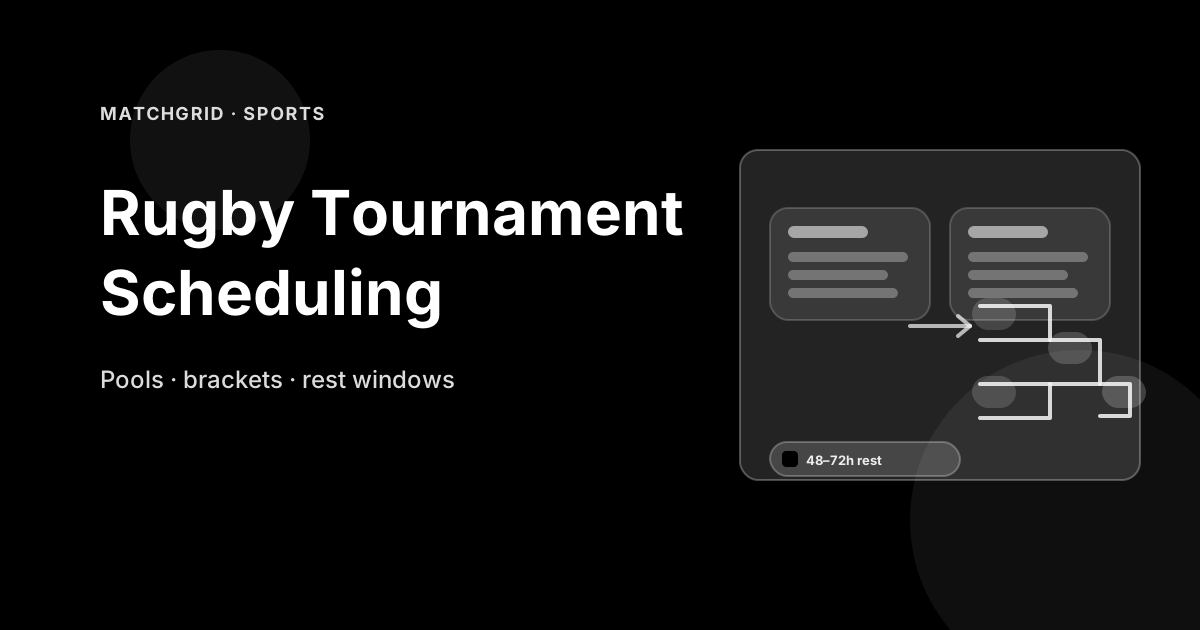
Rugby scheduling is the operational process of assigning matches to pitches across pools and brackets while optimizing fairness, feasibility, and logistics. Rugby tournaments face extreme scheduling complexity: matches require 90-minute windows (including warmup and recovery), teams need 48-72 hour rest between matches, and pool-to-bracket transitions must maintain competitive integrity. Effective rugby scheduling requires constraint optimization across multi-day events.
Tournament directors managing rugby sevens or fifteens events confront a logistics challenge that spreadsheets cannot solve: balancing match frequency, rest requirements, pitch capacity, and bracket fairness across 16-32 teams over 2-3 days.
What makes rugby scheduling complex
Rugby scheduling complexity stems from physical and structural constraints:
Rest requirement severity: Rugby is among the most physically demanding sports. Teams require 48-72 hours between matches for injury recovery and performance readiness. Violating rest requirements creates player safety risks and competitive unfairness.
Match duration and pitch capacity: A rugby match requires 80-90 minutes including warmup, play, and recovery. A pitch hosting 4 matches per day reaches capacity. Multi-pitch venues can parallelize matches but create referee and medical staff allocation challenges.
Pool-to-bracket structural complexity: Tournaments use pool play (round-robin within groups) followed by bracket elimination. Pool standings determine bracket seeding. Scheduling pool matches to complete simultaneously ensures no team gains competitive intelligence advantage. Bracket matches must preserve rest requirements while completing within tournament deadlines.
Schedule rugby correctly Build fair, conflict-free schedules using MatchGrid’s constraint engine. Rugby scheduling software
The real-world constraints behind rest requirements and pool structures
Rest requirements in rugby reflect player safety and competitive integrity:
Injury prevention: Rugby sevens requires 3-4 hours minimum between matches. Rugby fifteens requires 48-72 hours. Shorter rest windows increase injury risk exponentially. Tournament insurance and liability require documented rest compliance.
Performance equity: Teams playing on short rest face significant competitive disadvantage. A team playing Saturday morning and Sunday evening has 36 hours rest. A team playing Saturday evening and Monday morning has 60 hours rest. This 24-hour difference affects match outcomes.
Pool structure fairness: Pools must have equal team counts (4 teams per pool for 16-team tournaments). Unbalanced pools create bracket seeding inequity. Pool match scheduling must ensure all pools complete simultaneously to prevent competitive intelligence leaks.
A rugby tournament scheduler must encode rest requirements as hard constraints and validate pool structural integrity before generation.
How scheduling breaks when done manually
Manual rugby tournament scheduling collapses predictably:
Rest violation failures: Tracking rest windows across 32 teams and 80+ matches exceeds human working memory. Teams are scheduled with 24-hour rest when 48 hours is required. Safety violations surface too late to correct.
Pitch capacity overflows: Manual pitch allocation double-books pitches or exceeds daily capacity. Matches delay. The tournament runs past sunset. Evening matches are canceled or relocated.
Bracket seeding errors: Pool standings determine bracket placement. Manual seeding introduces errors: top pool finishers face each other in quarterfinals instead of semifinals. Competitive integrity collapses.
A constraint-based scheduling method that works
Effective rugby tournament scheduling follows structured logic:
1. Model pool structures: Divide teams into balanced pools (4 teams per pool for 16-team events). Generate round-robin matches within each pool.
2. Encode rest and pitch constraints: Define minimum rest windows (48-72 hours). Model pitch capacity (matches per pitch per day). Encode constraints as a constraint satisfaction problem (CSP).
3. Generate pool schedules with simultaneous completion: Assign pool matches to pitches and time slots ensuring all pools complete at the same time. This prevents competitive intelligence leaks.
4. Generate bracket structures from pool results: Seed bracket based on pool standings. Assign bracket matches to pitches while preserving rest requirements and completing within tournament deadlines.
Modern rugby tournament scheduling platforms automate this process, reducing 15+ hours of manual bracket generation to 5 minutes of setup plus 1 minute of generation.
Schedule rugby correctly Build fair, conflict-free schedules using MatchGrid’s constraint engine. Rugby scheduling software
Checklist: What to collect before scheduling
Before generating a rugby tournament schedule, collect:
- Team count and pool structure: 16 teams = 4 pools of 4 teams, 32 teams = 8 pools of 4 teams
- Tournament dates: Start date, end date, daily start/end times
- Pitch availability: Number of pitches, usable hours per day
- Rest requirements: Minimum hours/days between matches (sevens: 3-4 hours, fifteens: 48-72 hours)
- Match duration: Warmup + game + recovery time (sevens: 20-30 minutes, fifteens: 90-100 minutes)
- Bracket structure: Single elimination, double elimination, or consolation brackets
- Referee pool: Available referees, simultaneous match limits
- Medical staff: Required medical personnel per pitch
Complete data collection prevents infeasible schedules and safety violations.
How modern scheduling engines handle this
Constraint-based scheduling engines for rugby tournaments operate in phases:
Phase 1: Pool structure validation: Verify team count divides evenly into pools. Generate round-robin matches within each pool.
Phase 2: Constraint modeling: Encode rest requirements, pitch capacity, referee availability, and simultaneous completion constraints as a CSP.
Phase 3: Pool schedule generation: Assign pool matches to pitches and time slots using constraint propagation. Ensure all pools complete simultaneously.
Phase 4: Bracket seeding and generation: Calculate pool standings, seed bracket, and assign bracket matches while preserving rest requirements.
Phase 5: Feasibility validation: Verify tournament completes within available time, pitch capacity, and rest constraints. Report conflicts if infeasible.
This approach scales to 64-team tournaments and guarantees rest compliance.
Schedule rugby correctly Build fair, conflict-free schedules using MatchGrid’s constraint engine. Rugby scheduling software
FAQ
How many pitches do I need for a 16-team tournament? For rugby fifteens with 48-hour rest, a 2-day tournament needs 2-3 pitches. For rugby sevens with 4-hour rest, a 1-day tournament needs 3-4 pitches depending on match duration.
Can the schedule handle late-arriving teams? Adjust team count and regenerate pool structures instantly. The engine rebalances pools and reschedules all matches in under 60 seconds.
What if pool play runs long and delays brackets? The system validates total tournament duration during generation. If infeasible, it reports the conflict. You can extend tournament hours, add pitches, or reduce pool size and regenerate.
How is bracket seeding calculated? Pool standings are based on wins, point differential, and head-to-head results. The engine applies standard tournament seeding rules (e.g., Pool A winner plays Pool D runner-up).
Does this work for rugby sevens and fifteens? Yes. The constraint engine handles both formats. Rest requirements and match duration differ, but the underlying scheduling logic is identical.
Conclusion
Rugby tournament scheduling requires rest compliance, pitch capacity management, and bracket structural integrity. Manual methods cannot track rest windows, balance pools, and generate brackets without errors. Constraint-based engines automate pool play, enforce rest requirements, and generate fair brackets instantly. For tournament directors managing multi-day rugby events, automation eliminates safety risks and competitive integrity failures.
Explore how MatchGrid’s constraint engine can transform your rugby tournament operations.