Wrestling scheduling is the operational process of assigning matches to mats across weight classes and brackets while optimizing fairness, feasibility, and logistics. Wrestling tournaments face unique structural complexity: 14 weight classes each require separate brackets, matches occur simultaneously across 4-6 mats, and athletes cannot compete in multiple weight classes. Effective wrestling tournament scheduling requires weight class bracket generation, mat allocation logic, and rotation management that manual methods cannot provide.
Tournament directors managing high school or collegiate wrestling championships confront a scheduling challenge unique to weight-classed sports: 200 wrestlers competing across 14 weight classes require 400+ matches scheduled across 6 mats over 8-10 hours. Bracket generation, seeding, and mat allocation must maintain fairness while completing on schedule.
What makes wrestling scheduling complex
Wrestling tournament complexity stems from weight class multiplicity:
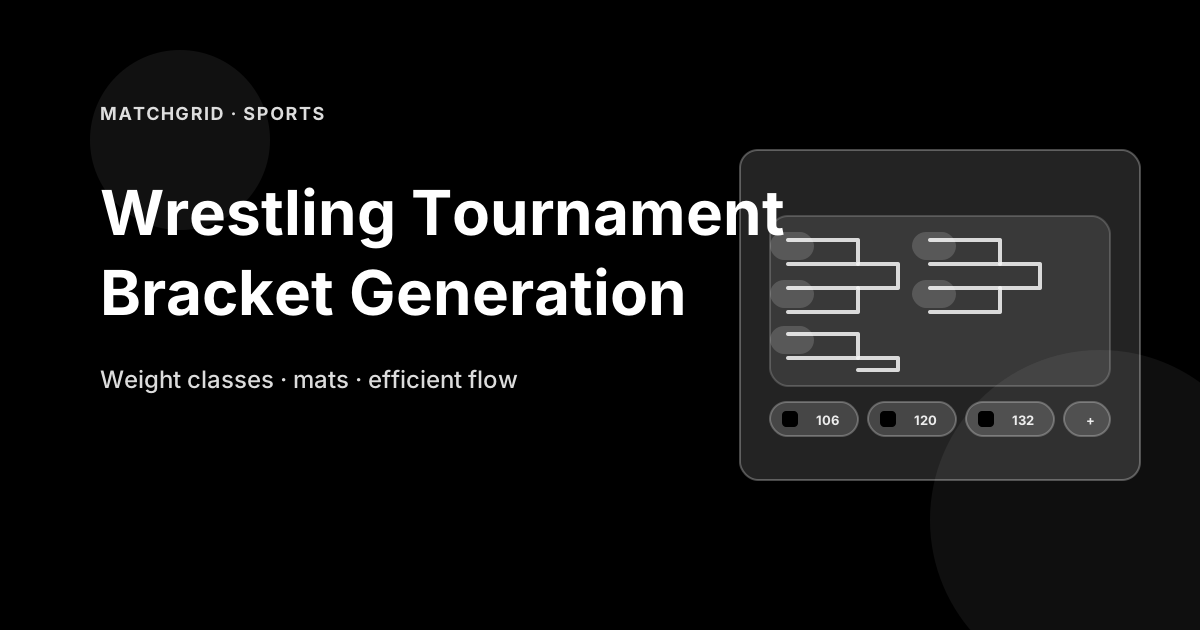
14 independent bracket structures: Each weight class (106 lbs, 113 lbs, 120 lbs, etc.) requires a separate bracket. Brackets may be 4-person, 8-person, 16-person, or 32-person depending on athlete entries. Generating 14 brackets manually takes hours and creates seeding errors.
Mat allocation and rotation: Matches from multiple weight classes occur simultaneously across 4-6 mats. Scheduling matches to keep all mats active while ensuring wrestlers have adequate rest between matches requires precise rotation logic. Mat allocation errors create idle mats and tournament delays.
Seeding complexity: Wrestlers are seeded within weight classes based on season records, previous tournament results, or coach rankings. Seeding errors (e.g., #1 seed faces #2 seed in quarterfinals instead of finals) destroy competitive integrity and trigger protests.
Schedule wrestling correctly Build fair, conflict-free schedules using MatchGrid’s constraint engine. Wrestling scheduling software
The real-world constraints behind bracket generation and mat allocation
Bracket generation constraints reflect competitive fairness and structural requirements:
Seeding logic: Top seeds should be placed in opposite bracket regions to meet in finals. #1 seed meets #8 seed in quarterfinals, #4 seed meets #5 seed. Proper bracket placement requires algorithmic seeding, not manual placement.
Bye distribution: If a weight class has 13 wrestlers, 3 wrestlers receive first-round byes. Byes must distribute fairly based on seeding (top 3 seeds receive byes). Manual bye assignment creates errors and complaints.
Mat rotation fairness: Wrestlers need 30-60 minutes between matches for recovery. Scheduling a wrestler’s second match 15 minutes after their first match violates recovery requirements and creates competitive disadvantage.
A wrestling bracket generator must seed brackets algorithmically, distribute byes fairly, and allocate matches to mats while enforcing recovery windows.
How scheduling breaks when done manually
Manual wrestling tournament scheduling collapses predictably:
Seeding errors: Manual bracket placement puts #2 seed in the same bracket region as #1 seed. They meet in semifinals instead of finals. Coaches protest. Tournament credibility suffers.
Mat allocation failures: Matches concentrate on 3 mats while 3 mats sit idle. Tournament duration extends 2+ hours beyond schedule. Wrestlers wait 90+ minutes between matches. Performance degrades.
Bye distribution errors: Top seeds don’t receive byes. Lower seeds advance through first round while top seeds wrestle immediately. Competitive unfairness triggers formal protests.
A constraint-based scheduling method that works
Effective wrestling tournament scheduling follows structured logic:
1. Generate brackets per weight class: For each weight class, determine bracket size (4, 8, 16, 32 wrestlers). Generate bracket structure with proper seeding placement (#1 seed in position 1, #2 seed in position 16 for 16-person brackets).
2. Distribute byes algorithmically: If bracket size doesn’t match entry count, calculate required byes and assign to top seeds automatically.
3. Allocate matches to mats: Assign matches to mats using rotation logic that balances mat utilization and enforces wrestler recovery windows. Optimize to minimize tournament duration.
4. Validate competitive integrity: Verify top seeds are placed in opposite bracket regions, byes distribute fairly, and match sequencing preserves competitive fairness.
Modern wrestling tournament scheduling platforms automate bracket generation, seed placement, bye distribution, and mat allocation, reducing 8+ hours of manual work to 10 minutes of entry plus 90 seconds of generation.
Schedule wrestling correctly Build fair, conflict-free schedules using MatchGrid’s constraint engine. Wrestling scheduling software
Checklist: What to collect before scheduling
Before generating a wrestling tournament schedule, collect:
- Wrestler entries by weight class: Which wrestlers compete in which weight classes
- Seeding data: Season records, previous tournament results, coach rankings
- Tournament format: Single elimination, double elimination, consolation brackets
- Mat availability: Number of mats, usable hours, setup/breakdown time
- Match duration: Regulation time plus overtime, rest between matches on same mat
- Recovery requirements: Minimum time between matches for the same wrestler (typically 45-60 minutes)
- Officials and scorekeepers: Available referees, scoring table capacity
- Medal round timing: Finals and consolation finals timing preferences
Incomplete seeding data creates bracket errors and competitive integrity failures.
How modern scheduling engines handle this
Constraint-based scheduling engines for wrestling tournaments operate in phases:
Phase 1: Bracket generation per weight class: For each weight class, generate bracket structure based on entry count. Apply standard seeding logic (#1 and #2 seeds in opposite regions).
Phase 2: Bye distribution: Calculate required byes (bracket size - entry count). Assign byes to top seeds algorithmically.
Phase 3: Mat allocation optimization: Assign matches to mats using constraint propagation. Balance mat utilization, enforce recovery windows, minimize tournament duration.
Phase 4: Competitive integrity validation: Verify seeding correctness, bye distribution fairness, and bracket structural integrity. Report errors before finalization.
Phase 5: Real-time adjustment: Support mid-tournament adjustments (wrestler withdrawals, injury defaults) with instant bracket and mat schedule regeneration.
This approach scales to 300+ wrestler tournaments and guarantees competitive fairness.
Schedule wrestling correctly Build fair, conflict-free schedules using MatchGrid’s constraint engine. Wrestling scheduling software
FAQ
How is bracket size determined? Bracket sizes are powers of 2 (4, 8, 16, 32). The system selects the next bracket size larger than the entry count. If 13 wrestlers enter, a 16-person bracket is generated with 3 byes.
What if a wrestler withdraws mid-tournament? The system adjusts the bracket, advances the opponent by default, and regenerates remaining match assignments to affected mats instantly.
Can seeding be adjusted manually? Yes. Import initial seeding data, review bracket placement, adjust seeds if necessary, and regenerate brackets. The system applies seeding logic automatically.
How many mats are needed for a 200-wrestler tournament? For a 10-hour tournament with 14 weight classes and 400+ matches, you need 5-6 mats minimum to complete on schedule.
Does this work for dual meets and tournaments? Yes. Dual meets use all 14 weight classes sequentially on 1-2 mats. Tournaments use concurrent matches across 4-6 mats. The constraint engine handles both formats.
Conclusion
Wrestling tournament scheduling requires algorithmic bracket generation, seeding logic, bye distribution, and mat allocation optimization. Manual methods create seeding errors, mat allocation failures, and tournament delays. Constraint-based engines generate brackets automatically, seed fairly, distribute byes correctly, and optimize mat rotations to complete tournaments on schedule. For tournament directors managing multi-weight-class championships, automation eliminates bracket errors and ensures competitive integrity.
Explore how MatchGrid’s constraint engine can transform your wrestling tournament operations.