Artificial intelligence is transforming how sports events are scheduled and managed. Organizing games, practices, and tournaments involves juggling team availability, venues, and fairness—a complex puzzle that traditionally required days of manual effort. Modern AI-driven scheduling tools can handle these challenges with speed and precision, creating optimized schedules for youth, amateur, and school sports (everything outside the major professional leagues).
This research explores how AI-powered scheduling benefits both the consumer side (players, families, coaches) and internal operations (league administrators, organizers), and examines the technical capabilities, feasibility, and limitations of such AI systems.
Consumer-Facing Benefits of AI Scheduling Tools
AI-driven scheduling platforms greatly enhance the experience for athletes, families, and fans by making schedules more convenient, fair, and accessible. Key consumer-facing impacts include:
Greater Convenience and Mobile Access
AI scheduling tools often come with integrated web or mobile apps that keep everyone instantly informed. Schedules are mobile-ready, allowing parents and coaches to access game times from anywhere. When an organizer publishes or updates a schedule, teams receive automatic notifications without needing manual emails.
This real-time access means no more confusion about last-minute changes—if a field or time slot shifts, everyone’s app updates immediately. Families can even get reminders and add schedules to their personal calendars, reducing the chance of missed games.
Enhanced Engagement and Real-Time Updates
By integrating with live data, AI platforms can boost fan and player engagement. For example, some systems sync game schedules with live scores and standings. Parents can check scores as they’re updated online or via the app, and coaches see standings as soon as games finish.
This creates an experience that “feels like a pro event” for youth sports users. Rather than just a static list of games, the schedule becomes an interactive hub, keeping everyone engaged and informed throughout the season or tournament. This level of connectivity and instant information was previously only expected in professional sports, but AI tools bring it to community sports events.
Fairness and Transparency for Participants
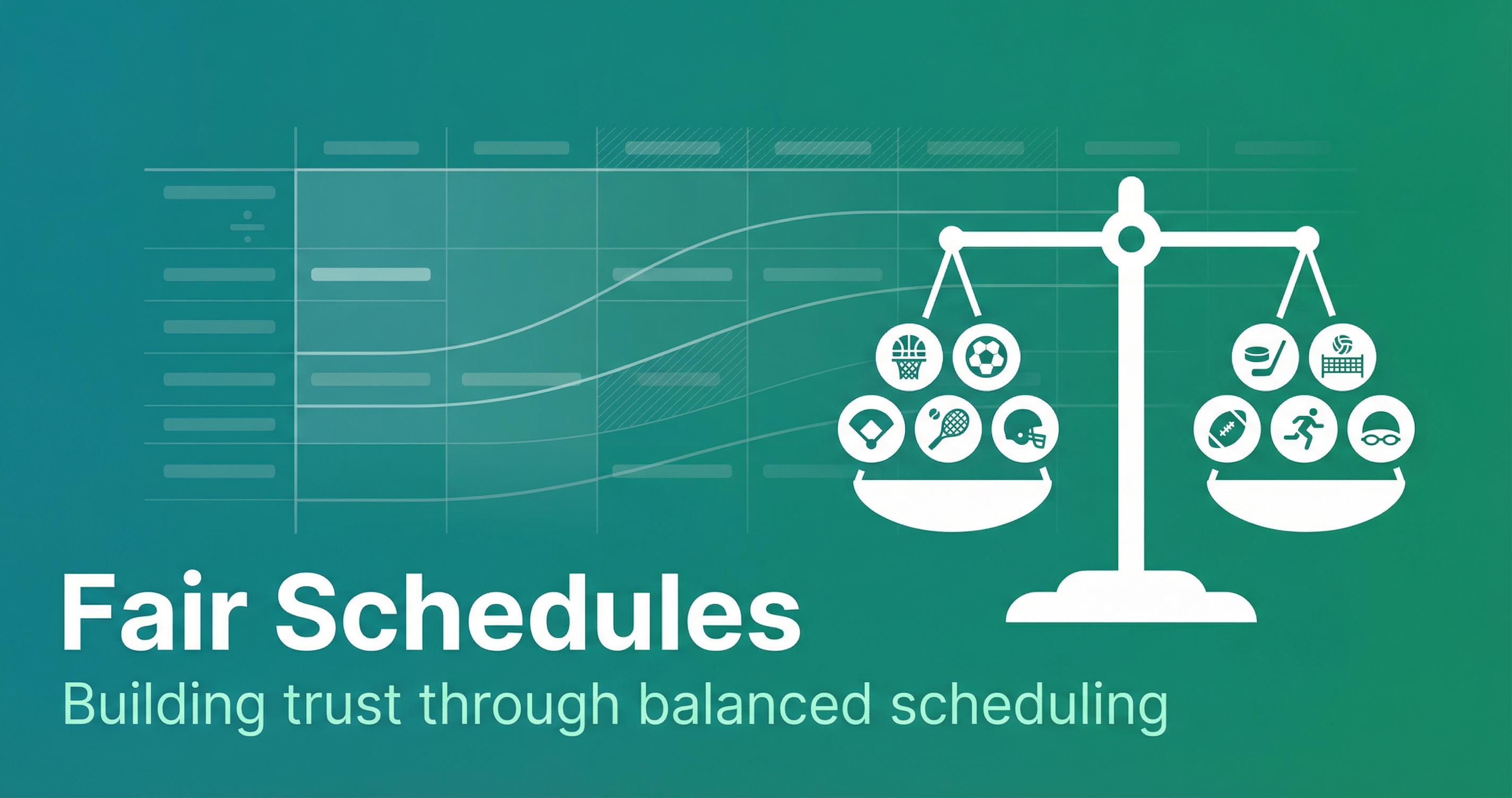
AI scheduling algorithms strive to produce fair, balanced schedules, which leads to happier teams and fewer complaints. Unlike ad-hoc human scheduling that might inadvertently favor certain teams, AI can ensure each team gets equitable game times (no one gets stuck with all 7 A.M. games or double-headers with no rest).
For instance, AI can balance home/away games, enforce minimum rest periods between matches, and avoid giving any team an unfair advantage. One league that switched to an AI-based scheduler reported fewer complaints from parents and coaches because all teams received fair game times. This transparency builds trust—teams feel the schedule is objectively set by rules, not by favoritism, improving overall satisfaction.
Improved Communication and Engagement
Many AI scheduling platforms double as communication tools, keeping everyone in the loop effortlessly. A good example is TeamLinkt’s “Emi” AI assistant, which can handle communication tasks like sending out automated reminders and announcements to teams.
Instead of an organizer manually emailing updates or coaches having to relay changes, the AI ensures notifications, reminders, and announcements are sent automatically to the right people. This leads to more engaged participants—coaches and families stay updated without extra effort, and volunteers spend less time answering routine schedule questions from confused parents.
A Pro-Level Experience for Amateur Sports
By handling scheduling complexities, AI lets even small youth tournaments feel more professional for participants. Events run on time and information flows smoothly, which gives fans a better experience—one that feels like a pro event.
Features like live updates, fair matchups, and well-communicated schedules all contribute to a more enjoyable experience for players and spectators alike. Families are happier when game times are predictable and reasonable, coaches appreciate having less last-minute chaos, and athletes can focus on performance instead of logistics.
Operational Benefits for Scheduling and Administration
On the operational side, AI-based scheduling tools offer powerful capabilities that streamline administration and optimize the use of resources. League administrators, schedulers, and athletic directors see major improvements in efficiency and accuracy.
Automated Conflict Resolution and Efficiency
One of AI’s biggest strengths is eliminating scheduling conflicts and errors that plague manual planning. AI scheduling systems can analyze all the constraints—team availability, venue availability, referee schedules, etc.—and automatically detect and resolve conflicts like double-booked fields or overlapping game times.
This means no more accidental double-booking of a gym or scheduling a coach to be in two places at once. The AI quickly suggests or implements solutions (such as adjusting times or swapping venues) to fix conflicts instantly. As a result, organizers avoid headaches and emergency fixes; one report noted AI cut scheduling conflicts by 85% compared to manual methods.
The entire schedule creation becomes far more efficient—some AI tools can generate a complete schedule in minutes, which is 4–5× faster than traditional methods. This frees up administrators to focus on other tasks rather than spending days tweaking spreadsheets.
Reduced Administrative Workload
By automating routine tasks, AI dramatically lowers the labor for league and tournament organizers. Scheduling used to be a time-consuming “nightmare” of spreadsheets and phone calls, often taking coordinators dozens of hours per season. Now, AI handles the heavy lifting.
For example, TeamLinkt’s AI assistant can quickly generate fair and conflict-free game and practice schedules, essentially doing in moments what might take a person many hours. One tournament organizer reported saving over 30 hours of work by letting AI handle the schedule generation.
Beyond scheduling itself, AI assistants can also automate peripheral admin tasks—eliminating repetitive data entry. All of this reduces the administrative burden and human error, allowing sports directors to focus on what truly matters—creating a great experience for athletes instead of paperwork.
Optimized Resource Utilization
AI doesn’t just schedule games; it optimizes how they’re scheduled. This means making the smartest use of fields, courts, and staff. An AI scheduler can consider venue capacities, locations, and availability to maximize facility usage without conflicts.
For instance, the system might group games by location to minimize travel, or stagger start times to avoid congestion. One example scenario: a youth soccer league had 48 games across 8 fields—an AI system grouped nearby teams and minimized travel time while ensuring fair field distribution, effectively using every field to its full potential.
Similarly, AI can assign referees and officials more efficiently, ensuring they aren’t double-booked and reducing idle time. Overall, this smart allocation means fewer empty field slots, less downtime, and better use of limited resources.
Adaptive Rescheduling and Reliability
Sports events often face unexpected changes—a sudden thunderstorm, a team dropping out, or a last-minute coach conflict. AI scheduling tools excel at adapting to changes on the fly. They can integrate real-time data (like weather forecasts) and have contingency plans ready.
For example, AI-driven systems monitor weather in real time and proactively reschedule games if a storm is coming, automatically notifying all teams and officials of the adjusted plan. This means a rain-out that would have caused chaos is handled smoothly, with backup venues or times already identified by the algorithm.
Likewise, if a team withdraws or a new team is added last-minute, the AI can re-optimize the schedule quickly, avoiding a domino effect of issues. Such agility makes the overall operations far more reliable and reduces the stress on administrators to make quick decisions under pressure.
Competitive Balance and Better Experiences
Internally, organizers are often concerned with ensuring a fair competition and good experience for all teams. AI can help here by using data-driven approaches to maintain competitive balance. Advanced scheduling algorithms can take into account team strength, past performance, or league rankings to craft a schedule that is balanced and exciting.
For instance, an AI might ensure top-ranked teams don’t all face each other in the first round of a tournament, or it might schedule games to maximize rest for teams in later playoff rounds to keep competition high. Predictive analytics can be used to ensure competitive balance in league schedules.
By removing subjective decisions and possible bias, AI scheduling provides objective fairness, giving all participants equal opportunities. A great schedule sets the tone for a great event—it builds trust and increases the likelihood that teams return year after year.
Key AI Capabilities and Technologies in Sports Scheduling
Building a powerful sports scheduling tool involves combining several AI techniques and technologies, each contributing different capabilities. Rather than a full technical stack, it’s useful to understand these in terms of what they enable.
Advanced Scheduling Optimization Algorithms
At the heart of an AI scheduling tool is usually an optimization engine—often a form of AI that can sift through countless scheduling possibilities to find the optimal one. This could involve algorithms from operations research (like constraint solvers, genetic algorithms, or integer programming) tailored with AI heuristics for sports.
These algorithms excel at processing thousands of potential schedule combinations and finding one that satisfies all the rules and preferences. For example, the AI will consider constraints (game duration, travel times, field availability, team conflicts) and objectives (minimize gaps, maximize rest, balance home/away games) and then compute the best schedule that fits.
This capability far exceeds a human’s manual trial-and-error approach—the AI can guarantee no double-bookings and meet complex criteria that would be overwhelming to do by hand. Notably, companies like Fastbreak emphasize that their scheduling AI is based on “very advanced math” designed specifically for optimization—“it’s not ChatGPT” or a simple set of filters.
Predictive Analytics and Data-Driven Insights
Another AI capability in scheduling tools is the use of predictive models to improve decision-making. Predictive analytics can forecast things like team performance, attendance, or resource needs, which in turn inform scheduling decisions.
For instance, an AI might analyze historical data to predict which games will be high-stakes or draw big crowds, and then schedule those at prime times or larger venues. AI can also learn from past seasons to anticipate where conflicts or issues might arise.
Some advanced tournament schedulers even use predictive modeling to generate optimal brackets, simulating a tournament ahead of time to design a bracket that maximizes excitement and fairness.
Natural Language Interfaces (LLMs) for User Interaction
Large Language Models (LLMs) like GPT-4 can be incorporated to make scheduling tools more user-friendly and intelligent in interactions. While LLMs are not used for the heavy optimization math, they shine in understanding and generating language.
This capability can be leveraged in a few ways. An AI assistant or chatbot interface allows users to ask questions or make requests in plain language. For example, an organizer could type, “Schedule a round-robin tournament for 8 teams with finals on Sunday afternoon,” and an LLM-driven interface could interpret that and trigger the scheduling algorithm accordingly.
The key benefit is improved usability and productivity: users spend less time navigating complex menus or manual data entry, and can instead “tell” the AI what to do in intuitive terms.
Automation of Administrative Tasks
Beyond the schedule computation itself, AI brings general automation capabilities that streamline sports management. Once an AI has generated a schedule, it can automatically publish that schedule and trigger notifications to all participants—a task that used to require manual emailing or posting.
AI scheduling systems also often integrate with other tools (registration systems, ticketing, etc.), so data flows seamlessly. In short, the AI acts as a diligent assistant that never forgets to update every record, reducing duplicate data entry and chances for inconsistency.
Integration of External Data and Constraints
A powerful AI scheduling tool is also capable of taking into account external factors that traditional tools ignore. For example, integration with weather data allows the system to adjust schedules around forecasts. Integration with mapping or traffic data could let the AI avoid scheduling two games back-to-back if they are across town from each other.
AI can also respect custom constraints like facility rules or league policies automatically. These are intricate details that an AI can systematically handle, ensuring the generated schedule is not only mathematically feasible but practically realistic.
Strengths and Limitations of AI in Scheduling
AI brings remarkable capabilities to sports scheduling, but it’s also important to recognize what AI is good at and not so good at in this domain.
AI Strengths
AI algorithms excel at handling complexity and volume of data that humans struggle with. They can consider dozens of factors simultaneously and check thousands of possible schedules far faster than any person. This means AI finds solutions that humans might miss—for instance, an arrangement of games that minimizes conflicts and travel for all teams.
AI is also extremely fast and consistent: once set up, it can generate a schedule or recompute updates in minutes or seconds. It will do this without arithmetic mistakes or forgetting a constraint, thereby eliminating common errors like double-bookings.
Another strength is adaptability: AI can dynamically adjust to changes (weather, team changes) and immediately provide an updated plan. It’s also tireless; it can send notifications at midnight or create 1000-game brackets without complaint, saving humans from drudgery.
AI Limitations
Despite the power of AI, there are areas where human insight is still crucial. AI systems are only as good as the rules and data given to them. If certain preferences or nuances aren’t encoded, the AI might make a decision that, while logical, doesn’t sit well with people.
AI lacks inherent understanding of unquantified human factors like tradition, community preferences, or the “feel” of a schedule. It won’t know a local custom (e.g., avoiding games on a religious holiday or during school exams) unless that’s explicitly input as data.
Another limitation is the garbage-in, garbage-out problem: if team availability data or venue info is wrong or outdated, the AI might produce an unusable schedule. Humans must ensure data quality and be ready to correct the AI’s output if it misses the mark on something subtle.
Best practice is to use AI as an assistant, not a total replacement for human judgment—the AI handles the heavy lifting and routine adjustments, while humans set the strategic parameters and make fine-tuning decisions when needed.
See AI Scheduling in Action with MatchGrid
MatchGrid brings these AI capabilities to life with 14+ AI-powered features purpose-built for youth, amateur, and school sports scheduling. From intelligent conflict resolution to travel-aware optimization and weather-smart rescheduling, MatchGrid’s constraint engine transforms chaos into clean, fair schedules.
- ✓ AI-powered auto-scheduling engine
- ✓ Smart conflict detection & resolution
- ✓ Travel distance optimization
- ✓ Weather-aware rescheduling
- ✓ Feasibility scoring & what-if analysis
Try MatchGrid free →
Conclusion
The use of AI in sports scheduling offers a powerful leap forward in both technical capability and user experience. For consumers—whether they are players checking a mobile app for their next game or parents planning the family calendar—AI-driven schedule tools provide unmatched convenience, real-time updates, and a fair playing field.
For organizers and administrators, AI removes much of the grunt work and guesswork: schedules are optimized for efficiency and balance, resources are better utilized, and operations become more proactive and resilient to changes. Modern AI scheduling systems combine robust optimization algorithms, predictive analytics, and user-friendly AI assistants to deliver schedules that satisfy a wide array of constraints and preferences in a fraction of the time.
Importantly, implementing such a system is technically feasible today—many youth and amateur leagues are already saving hours of work and improving their events by leveraging AI. Best practices suggest starting with small steps (perhaps using AI for a specific task like conflict checking) and then scaling up as confidence grows.
Organizations that embrace these AI tools are finding that they can devote more energy to coaching, player development, and fan engagement, rather than spreadsheet wrangling. The result is not just a more efficient schedule, but a better sports experience overall. AI may not replace the need for human insight and final approval in scheduling, but it has proven to be an invaluable assistant—one that can elevate sports scheduling from a tedious chore into a smart, data-driven process.
The future of sports scheduling, from local leagues to large tournaments, is poised to be intelligently automated, benefiting everyone from the back-office to the sidelines.
Sources
- TeamLinkt Blog – “The Role of AI in Sports Scheduling: Making Youth Sports Organization Easier” (2025)
- Playbook Sports – “Top 5 AI Strategies for Optimizing League and Tournament Scheduling” (2025)
- Fastbreak AI – “What If Your Tournament Could Schedule Itself? AI-Powered Sports Scheduling Software”
- Fastbreak AI – “Features That Matter in a Tournament Schedule Maker”
- Fastbreak AI – Success Story: Attitude of Gratitude Tournament
- CallPlaybook – AI Scheduling vs. Manual Scheduling Benefits (2025)