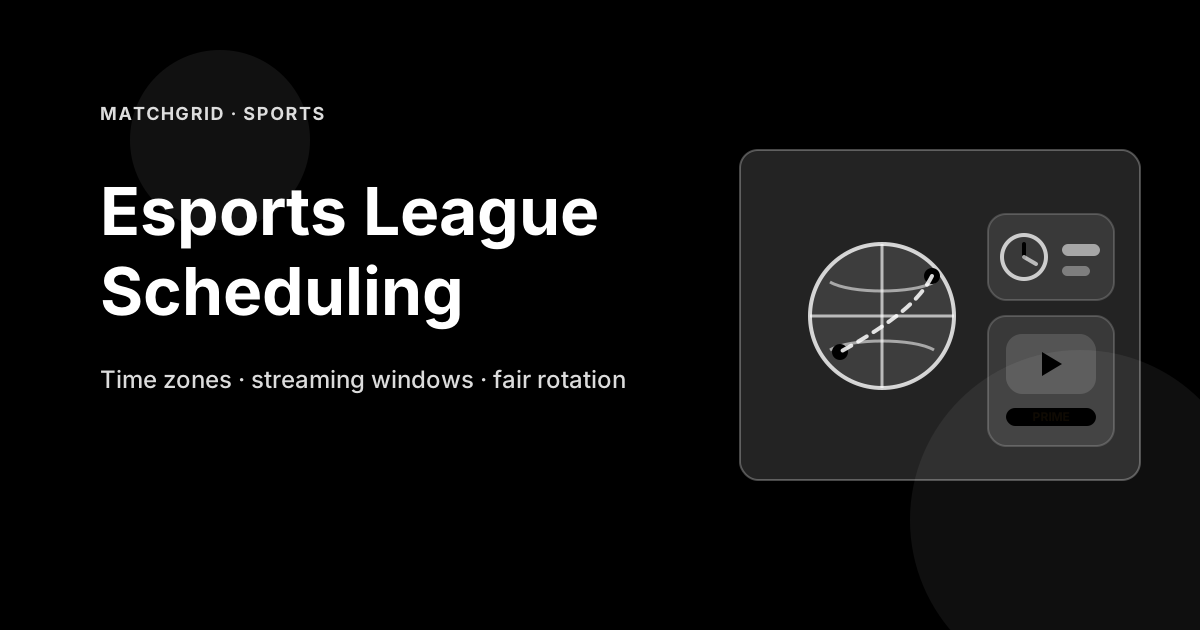
Esports scheduling is the operational process of assigning matches to time slots and streaming channels across distributed teams while optimizing fairness, feasibility, and logistics. Unlike physical sports, esports leagues operate across global time zones with teams in North America, Europe, and Asia competing in the same divisions. Effective esports scheduling requires time zone optimization, streaming window allocation, and fairness balancing that manual methods cannot provide.
League administrators managing competitive esports programs confront a scheduling challenge unique to digital sports: scheduling a match between a Los Angeles team and a London team requires finding a time that is fair for both (9 PM PT = 5 AM GMT). Multiplying this across 40 teams in 6 time zones creates constraint complexity manual spreadsheets cannot solve.
What makes esports scheduling complex
Esports scheduling complexity stems from time zone distribution and streaming requirements:
Global time zone coordination: Teams operate from PST, EST, GMT, CET, KST, and AEST time zones. A match time acceptable in Los Angeles (8 PM PT) translates to 4 AM in London and 1 PM in Seoul. Scheduling matches that provide competitive fairness across time zones requires optimization logic.
Streaming window constraints: Esports leagues broadcast matches on Twitch, YouTube, or proprietary platforms. Prime streaming windows (6-11 PM in major markets) maximize viewership. Scheduling matches outside streaming windows reduces engagement and sponsorship value. Competing with other leagues for streaming slots creates additional constraints.
Match rotation fairness: Teams expect balanced distributions of favorable and unfavorable match times. A team always playing at 2 AM local time faces competitive disadvantage. Fair scheduling rotates unfavorable time slots across all teams equally.
Schedule esports correctly Build fair, conflict-free schedules using MatchGrid’s constraint engine. Esports scheduling software
The real-world constraints behind time zone optimization and streaming windows
Time zone constraints reflect competitive equity and operational viability:
Player availability windows: Esports athletes have limited availability. College teams compete 6-11 PM local time. Professional teams follow training schedules (12 PM - 10 PM local time). Scheduling outside availability windows creates forfeiture risk.
Competitive fairness requirements: Scheduling a match at 10 PM for one team and 3 AM for another creates unfair competitive conditions. Player performance degrades significantly after midnight. Fatigue affects reaction time, decision-making, and coordination.
Streaming audience optimization: Streaming viewership peaks 7-10 PM in major markets (NA, EU, Asia). Scheduling marquee matches during off-peak hours reduces viewership by 60-70%. Sponsorship value declines. League revenue suffers.
An esports league scheduler must balance time zone fairness, player availability, and streaming optimization simultaneously.
How scheduling breaks when done manually
Manual esports league scheduling collapses predictably:
Time zone equity failures: Manual scheduling creates imbalanced time slot distributions. NA teams always play 8-10 PM while EU teams play 2-4 AM local time repeatedly. EU teams protest. Competitive integrity collapses.
Streaming window conflicts: Multiple matches schedule simultaneously during prime streaming windows. Viewership splits across streams. Sponsorship metrics decline. Matches scheduled at 11 AM local time get zero viewership.
Player availability conflicts: Matches schedule during player school or work hours. Teams forfeit or reschedule last-minute. The schedule becomes fragile and loses credibility.
A constraint-based scheduling method that works
Effective esports league scheduling follows time-zone-aware logic:
1. Model team time zones and availability: Identify each team’s local time zone. Encode player availability windows (e.g., weeknights 6 PM - 12 AM local time, weekends 12 PM - 12 AM local time).
2. Define fairness constraints: Each team should receive equal distributions of favorable (6-10 PM local), neutral (10 PM - 12 AM local), and unfavorable (12 AM - 6 AM local) match times across the season.
3. Optimize streaming windows: Identify prime streaming windows per region. Schedule marquee matches (top teams, playoff implications) during peak viewership hours.
4. Generate match assignments with time zone balancing: Use constraint propagation to assign matches to time slots that balance time zone fairness, respect player availability, and maximize streaming value.
Modern esports league scheduling platforms automate time zone balancing, optimize streaming windows, and enforce fairness constraints, reducing 30+ hours of manual coordination to 15 minutes of setup plus 1 minute of generation.
Schedule esports correctly Build fair, conflict-free schedules using MatchGrid’s constraint engine. Esports scheduling software
Checklist: What to collect before scheduling
Before generating an esports league schedule, collect:
- Team roster with time zones: Team names, primary time zones (PST, EST, GMT, etc.)
- Player availability windows: When teams can compete (weeknights 6 PM - 12 AM, weekends flexible)
- Season structure: Start date, end date, playoff dates, match frequency (2 matches/week)
- Streaming schedule: Available streaming channels, prime windows per region
- Fairness targets: Maximum acceptable unfavorable time slots per team
- Match format: Best-of-1, best-of-3, best-of-5 (affects match duration and scheduling density)
- Blackout dates: Holidays, major competing events (e.g., world championships)
- Broadcasting requirements: Which matches must be streamed vs can be off-stream
Incomplete time zone data creates competitive equity failures and player availability conflicts.
How modern scheduling engines handle this
Constraint-based scheduling engines for esports operate with time-zone awareness:
Phase 1: Time zone modeling: Map each team to its local time zone. Calculate match time translations (8 PM PST = 11 PM EST = 4 AM GMT).
Phase 2: Availability constraint encoding: Model player availability windows as time-based constraints. Reject match times outside availability windows.
Phase 3: Fairness optimization: Calculate time slot favorability per team (favorable = 6-10 PM local, unfavorable = 12 AM - 6 AM local). Balance distributions across teams using fairness scoring.
Phase 4: Streaming window allocation: Identify prime streaming windows. Assign high-value matches (top teams, rivalry matchups) to prime slots to maximize viewership.
Phase 5: Real-time adjustments: Support match rescheduling when teams request time changes. Regenerate schedules while preserving fairness constraints.
This approach scales to global leagues with 100+ teams across 8+ time zones.
Schedule esports correctly Build fair, conflict-free schedules using MatchGrid’s constraint engine. Esports scheduling software
FAQ
How do you balance time zones between NA and EU teams? Matches between NA and EU teams schedule during overlap windows (2-5 PM PST = 10 PM - 1 AM GMT). The system rotates which team gets favorable times across the season to ensure equity.
Can teams request specific match times? Yes. Teams can submit preferred time slots. The system treats preferences as soft constraints and optimizes where feasible without violating fairness or availability rules.
What if a team switches time zones mid-season? Update the team’s time zone and regenerate the remaining schedule. The system recalculates fairness distributions and adjusts future match times automatically.
How many streaming channels do we need? For a 40-team league with 2 matches per week, you need 1-2 streaming channels minimum. More channels allow simultaneous broadcasts and reduce scheduling density.
Does this work for tournaments and leagues? Yes. Tournaments use bracket structures instead of round-robin. Time zone balancing logic applies identically to both formats.
Conclusion
Esports league scheduling requires global time zone coordination, streaming window optimization, and competitive fairness balancing. Manual methods create time zone inequity, streaming conflicts, and player availability failures. Constraint-based engines model time zones explicitly, optimize streaming value, and enforce fairness constraints automatically. For league administrators managing distributed esports competitions, automation transforms time zone chaos into predictable competitive equity.
Explore how MatchGrid’s constraint engine can optimize your esports league scheduling operations.