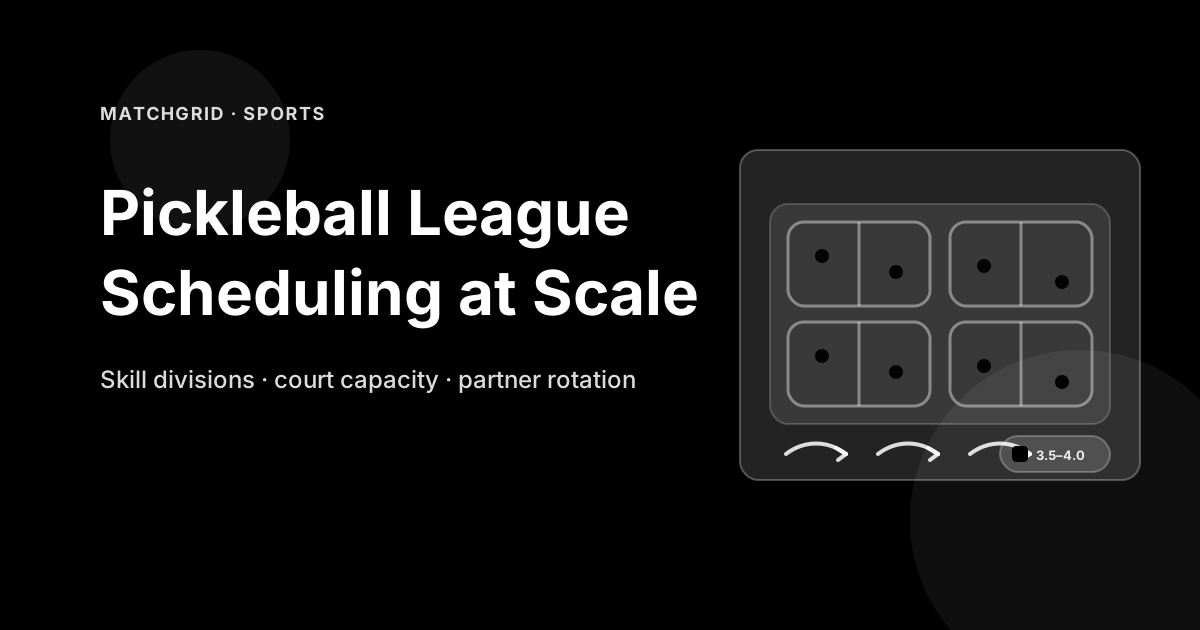
Pickleball scheduling is the operational process of assigning matches to courts across skill divisions while optimizing fairness, feasibility, and logistics. Pickleball leagues face explosive scaling complexity: a sport growing 40%+ annually creates massive demand for limited court resources, skill divisions (2.5, 3.0, 3.5, 4.0, 4.5) require separate scheduling to maintain competitive balance, and partner rotation formats require algorithmic pairing management. Effective pickleball league scheduling requires division-aware court allocation, partner rotation logic, and scalability optimization that manual methods cannot provide.
League directors managing pickleball programs confront a scheduling challenge unique to the fastest-growing sport in America: 200 players across 5 skill divisions competing over 12 weeks require 600+ matches scheduled across 8 courts with fair partner rotation, balanced skill matchups, and court utilization optimization.
What makes pickleball league scheduling complex
Pickleball scheduling complexity stems from explosive growth and skill division requirements:
Court capacity constraints meet explosive demand: Pickleball converts tennis courts (1 tennis court = 4 pickleball courts) but demand still exceeds supply. Leagues with 200+ players compete for 8-12 courts available 2-3 evenings per week. Scheduling 30+ simultaneous matches across limited courts requires precise allocation logic.
Skill division separation: Competitive pickleball uses skill divisions (2.5 = beginner, 3.0 = novice, 3.5 = intermediate, 4.0 = advanced, 4.5+ = elite). Mixing skill levels creates unfair matches and frustration. Scheduling requires division-specific matching and separate court blocks per division.
Partner rotation formats: Many leagues use rotating partner formats where players pair with different partners each week to build community. Generating partner pairings that ensure every player partners with every other player in their division requires algorithmic rotation management that manual methods cannot provide.
Schedule pickleball correctly Build fair, conflict-free schedules using MatchGrid’s constraint engine. Pickleball scheduling software
The real-world constraints behind court allocation and skill divisions
Court allocation constraints reflect resource scarcity and competitive equity:
Peak-time court competition: Pickleball leagues compete with tennis, recreational play, and lessons for court access. Evening slots (6-9 PM) are peak demand windows. Scheduling 5 skill divisions across 8 courts in a 3-hour window requires constraint optimization to prevent court idle time while respecting division separation.
Skill division integrity: Players self-rate or are rated by coordinators into skill divisions. A 3.0 player matched against 4.0 players loses repeatedly and becomes discouraged. A 4.5 player matched against 3.0 players dominates unfairly. Scheduling must enforce division boundaries rigidly.
Match duration variability: Pickleball matches vary in duration (15-45 minutes depending on format and skill level). Lower skill matches (2.5-3.0) often run longer than advanced matches (4.5+). Scheduling must account for duration variability to prevent court bottlenecks.
A pickleball league scheduler must allocate courts by division, generate partner rotations, and optimize court utilization automatically.
How scheduling breaks when done manually
Manual pickleball league scheduling collapses predictably:
Court allocation failures: Manual court assignment creates idle courts. Division 3.0 has 6 matches waiting while Division 4.0 has courts sitting empty. League duration extends 60+ minutes beyond schedule. Players leave. Subsequent court reservations are impacted.
Skill mixing errors: Players from different divisions are matched together due to manual pairing errors. 3.0 players face 4.0 players. Matches become uncompetitive. Players complain. League retention suffers.
Partner rotation incompleteness: Manual partner rotation creates repeated pairings or missed pairings. Some players partner together 3 times while never partnering with others in their division. Fairness collapses. Community-building goal fails.
A constraint-based scheduling method that works
Effective pickleball league scheduling follows division-aware logic:
1. Allocate courts by division and session: Divide available courts across skill divisions proportional to player counts. Division 3.5 with 60 players receives more court allocation than Division 4.5 with 20 players.
2. Generate partner rotations algorithmically: For rotating partner formats, use round-robin pairing algorithms to ensure every player partners with every other player in their division exactly once (or as evenly as possible across the season).
3. Optimize match scheduling within court blocks: Assign matches to courts within division-specific time blocks. Optimize court utilization to minimize idle time while accounting for match duration variability.
4. Balance session timing across divisions: Rotate which divisions play early sessions vs late sessions to ensure equity (Division 3.0 doesn’t always play 8-10 PM slot).
Modern pickleball league scheduling platforms automate court allocation, partner rotation generation, and court utilization optimization, reducing 15+ hours of manual work to 20 minutes of setup plus 2 minutes of generation.
Schedule pickleball correctly Build fair, conflict-free schedules using MatchGrid’s constraint engine. Pickleball scheduling software
Checklist: What to collect before scheduling
Before generating a pickleball league schedule, collect:
- Player roster by skill division: Player names, skill ratings (2.5, 3.0, 3.5, 4.0, 4.5)
- Court availability: Number of courts, available days and times
- Season structure: Start date, number of weeks, playoff structure
- League format: Fixed partners, rotating partners, or open play
- Match format: Games to 11, games to 15, best 2 of 3, rally scoring
- Session duration: Total available time per session (e.g., 6-9 PM = 3 hours)
- Division priorities: If court conflicts occur, which divisions have priority
- Player availability: Blackout dates, vacation weeks
Incomplete skill division data creates mixed-skill matches and competitive equity failures.
How modern scheduling engines handle this
Constraint-based scheduling engines for pickleball operate with division awareness:
Phase 1: Division-based court allocation: Calculate player counts per division. Allocate courts proportional to division size. Validate total court capacity suffices for season completion.
Phase 2: Partner rotation generation: For rotating partner formats, generate pairing rotations using round-robin algorithms. Ensure every player partners with every other player in their division.
Phase 3: Match scheduling optimization: Assign matches to courts within division-specific time blocks. Optimize to minimize idle court time while accounting for match duration variability.
Phase 4: Session timing equity: Rotate which divisions play early vs late sessions across the season. Prevent always-early or always-late scheduling for any division.
Phase 5: Scalability validation: Verify season completes within available courts and time windows. Report capacity shortfalls if infeasible.
This approach scales to 500+ player leagues across 10+ skill divisions.
Schedule pickleball correctly Build fair, conflict-free schedules using MatchGrid’s constraint engine. Pickleball scheduling software
FAQ
How many courts are needed for 200 players? For a 12-week season with rotating partners and 3-hour sessions, 200 players need 8-12 courts minimum depending on match format and session frequency (1x/week vs 2x/week).
Can players move between skill divisions mid-season? Yes. Adjust the player’s division assignment and regenerate. The system recalculates partner rotations and court allocations automatically.
What if court availability changes? Update court availability constraints and regenerate. The system reschedules all matches to available courts in under 60 seconds.
How is partner rotation fairness validated? The system generates a pairing matrix showing every player-partner combination. You can verify every player partners with every other player in their division the correct number of times.
Does this work for tournaments and leagues? Yes. Tournaments use bracket or round-robin structures instead of rotating partners. The constraint engine handles both league and tournament formats with division awareness.
Conclusion
Pickleball league scheduling requires division-aware court allocation, algorithmic partner rotation, and court utilization optimization. Manual methods create court allocation failures, skill mixing errors, and partner rotation incompleteness. Constraint-based engines allocate courts by division, generate fair partner rotations, optimize court utilization, and scale to 500+ player leagues automatically. For league directors managing explosive pickleball growth, automation transforms 15 hours of manual scheduling into predictable, equitable league operations.
Explore how MatchGrid’s constraint engine can scale your pickleball league scheduling operations.