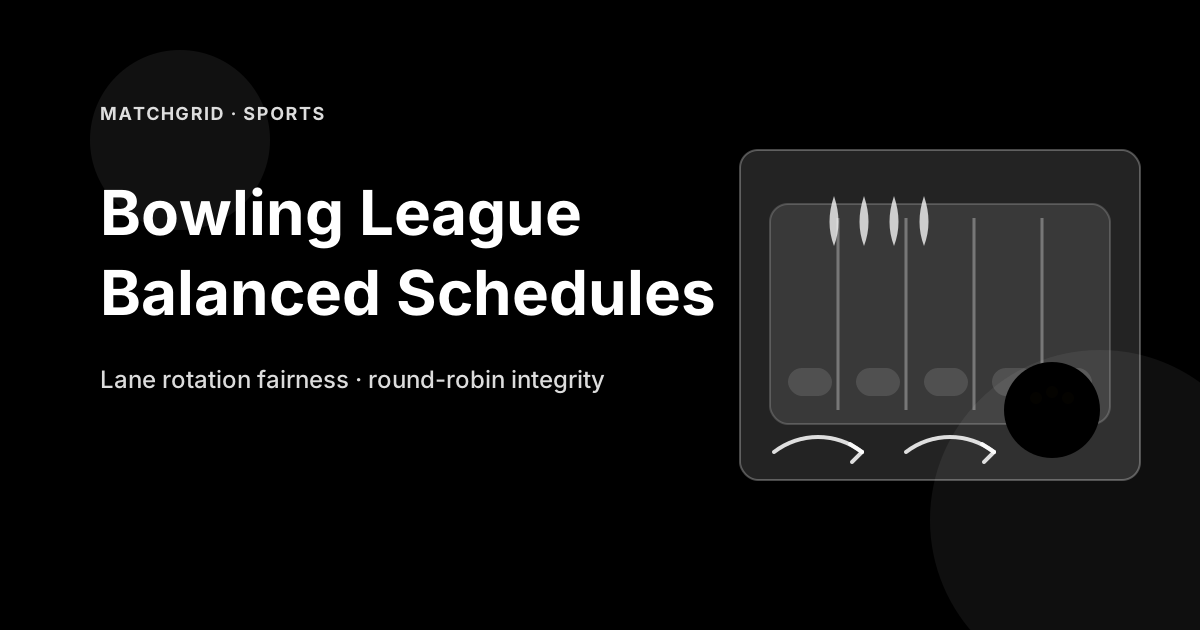
Bowling scheduling is the operational process of assigning matches to lanes across weeks while optimizing fairness, feasibility, and logistics. Bowling leagues face unique rotation complexity: teams must play every other team, lane assignments must rotate fairly to prevent home lane advantage, and handicap systems require accurate season-long opponent strength balancing. Effective bowling league scheduling requires round-robin generation, lane rotation logic, and strength-of-schedule optimization that manual methods cannot provide.
League directors managing bowling programs confront a scheduling challenge unique to lane-based sports: 16 teams competing over 20 weeks require 120 matchups scheduled across 8 lanes with fair lane rotation, balanced home/away distribution, and opponent strength equity across all teams.
What makes bowling league scheduling complex
Bowling league complexity stems from lane fairness requirements and rotation management:
Lane rotation fairness: Bowling lanes have subtle condition variations (oil patterns, pin deck characteristics, approach surface). Teams bowling on the same lanes repeatedly gain familiarity advantage. Fair scheduling rotates teams across all lanes throughout the season to eliminate lane-specific advantages.
Round-robin structural integrity: Competitive bowling leagues use round-robin formats where every team plays every other team. With 16 teams, that’s 120 matches over 15-20 weeks. Ensuring each team plays every opponent exactly once (or twice for double round-robins) requires structural validation that manual methods fail to enforce.
Strength-of-schedule balancing: Teams expect balanced opponent difficulty across the season. A team facing the top 5 teams in weeks 1-5 while another team faces bottom 5 teams creates competitive inequity. Opponent rotation must distribute strong and weak opponents evenly.
Schedule bowling correctly Build fair, conflict-free schedules using MatchGrid’s constraint engine. Bowling scheduling software
The real-world constraints behind lane rotation and opponent balancing
Lane rotation constraints reflect competitive fairness requirements:
Home lane advantage elimination: Teams bowling on their preferred lanes (e.g., lanes 5-6 every week) gain competitive advantage. Lane rotation systems (rotate 2 lanes per week) ensure all teams bowl on all lanes equally throughout the season.
Match duration and lane capacity: Bowling matches require 2-3 hours including warmup. Leagues with 16 teams need 8 simultaneous matches (2 teams per lane pair). Insufficient lane capacity creates scheduling bottlenecks and extends season duration beyond typical 16-20 week windows.
Bye week distribution: If team counts don’t divide evenly into matchups (e.g., 13 teams), some teams receive bye weeks. Bye distribution must balance fairly: no team receives 3 bye weeks while others receive 1. Manual bye allocation creates inequity complaints.
A bowling league scheduler must generate round-robin matchups, rotate lane assignments systematically, and balance strength-of-schedule automatically.
How scheduling breaks when done manually
Manual bowling league scheduling collapses predictably:
Lane rotation failures: Teams are assigned to the same lanes repeatedly. Home lane advantage creates competitive inequity. Teams complain. League credibility suffers.
Round-robin incompleteness: Manual matchup generation misses pairings. Some teams never play each other. Others play twice. Competitive integrity collapses. Standings become meaningless.
Strength-of-schedule imbalance: One team faces top opponents early while another team faces weak opponents early. Standings skew incorrectly. Playoff seeding becomes controversial.
A constraint-based scheduling method that works
Effective bowling league scheduling follows structured logic:
1. Generate round-robin matchups: Create all required pairings ensuring every team plays every other team. Validate structural completeness (no missing or duplicated pairings).
2. Encode lane rotation rules: Define lane rotation system (e.g., rotate 2 lanes per week clockwise). Ensure all teams bowl on all lanes equally across the season.
3. Distribute bye weeks fairly: If team count requires bye weeks, calculate required byes and distribute evenly across teams.
4. Optimize strength-of-schedule: Calculate opponent strength per team. Rotate matchups to balance strong and weak opponent distribution across the season.
Modern bowling league scheduling platforms automate round-robin generation, lane rotation, and strength-of-schedule balancing, reducing 10+ hours of manual work to 15 minutes of setup plus 1 minute of generation.
Schedule bowling correctly Build fair, conflict-free schedules using MatchGrid’s constraint engine. Bowling scheduling software
Checklist: What to collect before scheduling
Before generating a bowling league schedule, collect:
- Team roster: Team names, skill levels or handicaps
- Season structure: Start date, number of weeks, playoff dates
- Lane availability: Number of lanes, which lanes are usable
- Round-robin format: Single round-robin (play once) or double (play twice)
- Lane rotation system: Rotate 2 lanes per week, rotate 1 lane per week, or fixed lanes
- Bye week policy: How to handle bye weeks if team count is odd
- Match format: Best 2 of 3 games, total pinfall, baker format
- Handicap system: Percentage-based, absolute, or scratch (no handicap)
Incomplete team roster data creates structural failures and unfair schedules.
How modern scheduling engines handle this
Constraint-based scheduling engines for bowling leagues operate with fairness optimization:
Phase 1: Round-robin matchup generation: Generate all required team pairings. Validate completeness (every team plays every opponent exactly as specified).
Phase 2: Lane rotation encoding: Model lane rotation rules. Assign teams to lanes ensuring equal distribution across the season.
Phase 3: Bye week distribution: Calculate required bye weeks (if team count is odd). Distribute byes evenly across teams.
Phase 4: Strength-of-schedule optimization: Calculate opponent strength per team based on averages or handicaps. Rotate matchup order to balance opponent difficulty distribution.
Phase 5: Feasibility validation: Verify season completes within available weeks and lane capacity. Report conflicts if infeasible.
This approach scales to 40+ team leagues across multiple divisions.
Schedule bowling correctly Build fair, conflict-free schedules using MatchGrid’s constraint engine. Bowling scheduling software
FAQ
How is lane rotation implemented? The system assigns lane pairs per week and rotates them systematically (e.g., Team A bowls lanes 1-2 week 1, lanes 3-4 week 2, lanes 5-6 week 3). All teams follow the same rotation pattern.
Can teams request specific match dates? Yes. Teams can submit blackout dates (unavailable weeks). The system avoids scheduling matches during blackouts and regenerates automatically.
What if team count doesn’t divide evenly? The system allocates bye weeks to teams ensuring fair distribution. If 13 teams compete, one team receives a bye each week, rotated so all teams receive equal bye counts.
How is strength-of-schedule calculated? Opponent strength is based on team averages or handicaps. The system distributes strong and weak opponents evenly across the season to prevent early-season or late-season difficulty spikes.
Does this work for tournaments? Yes. Tournaments use bracket or stepladder formats instead of round-robin. The constraint engine handles both league and tournament structures.
Conclusion
Bowling league scheduling requires round-robin structural integrity, lane rotation fairness, and strength-of-schedule balancing. Manual methods create rotation failures, matchup incompleteness, and opponent imbalance. Constraint-based engines generate complete round-robins, rotate lanes systematically, and balance opponent strength automatically. For league directors managing competitive bowling programs, automation transforms 10 hours of manual scheduling into fair, balanced seasons.
Explore how MatchGrid’s constraint engine can optimize your bowling league scheduling operations.