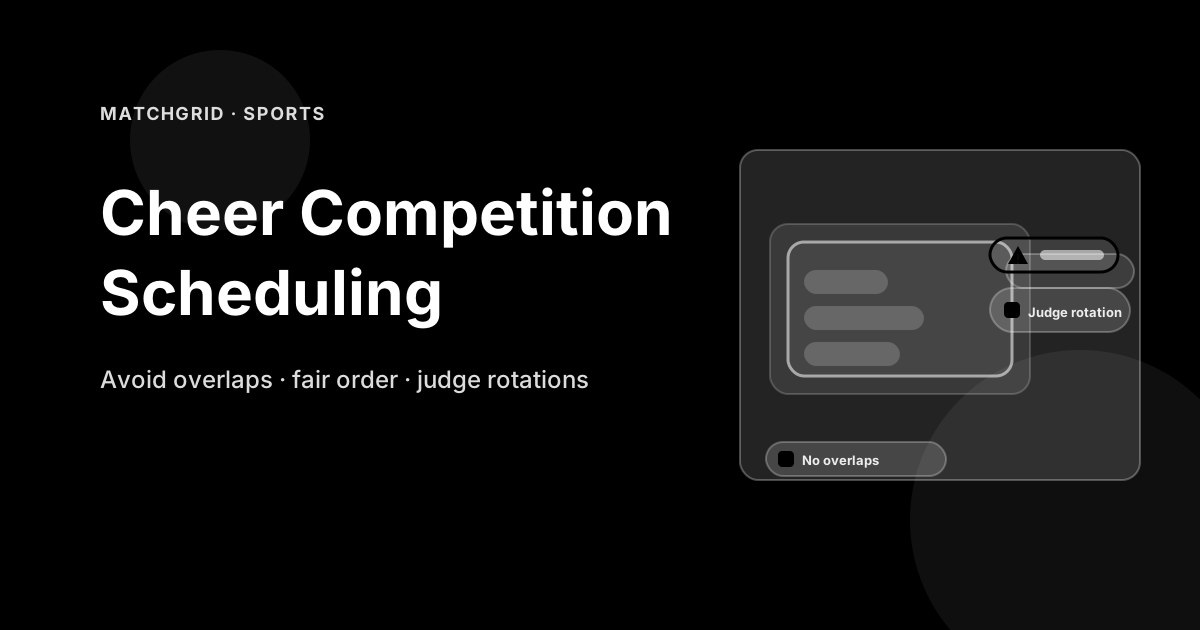
Cheer scheduling is the operational process of assigning performance slots to teams across divisions while optimizing fairness, feasibility, and logistics. Cheer competitions face unique coordination complexity: teams from 10-20 schools compete across multiple divisions (varsity, JV, novice), performances require 2-3 minutes with floor transitions between teams, and judge panels must rotate across divisions without conflicts. Effective cheer competition scheduling requires division sequencing, performance slot allocation, and judge rotation management that manual methods cannot provide.
Competition directors managing multi-school cheer events confront a scheduling challenge unique to performance sports: 60 teams competing across 6 divisions require 180 minutes of performance time plus 60 minutes of transitions, warmup coordination, and awards ceremonies—all within a 4-hour venue window.
What makes cheer competition scheduling complex
Cheer competition complexity stems from division structures and venue flow management:
Division timing and transitions: Competitions organize teams into divisions by skill level (novice, intermediate, advanced) and team type (varsity, JV). Each division requires separate judging and awards. Transitioning between divisions (clearing mats, rotating judges, adjusting sound systems) requires 10-15 minutes per division.
Performance slot allocation fairness: Teams expect balanced warmup time and performance order fairness. Always performing first or last creates perceived competitive disadvantage. Fair scheduling rotates performance order across divisions.
Judge panel coordination: Each division requires 3-5 judges. Competitions use shared judge pools across divisions. Judges need 15-20 minutes between divisions for scoring tabulation and rest. Allocating judges without creating conflicts or overload requires constraint optimization.
Schedule cheer competitions correctly Build fair, conflict-free schedules using MatchGrid’s constraint engine. Cheer scheduling software
The real-world constraints behind event coordination and overlap prevention
Event coordination constraints reflect venue capacity and competitive fairness:
Warmup-to-performance sequencing: Teams need 10-15 minutes of floor warmup before performing. Warmup and performance schedules must coordinate: warmup groups rotate off the floor as performance groups rotate on. Scheduling conflicts create delays and performance quality degradation.
Venue capacity limits: Competition venues have single performance floors. Only one team performs at a time. Maximizing venue utilization requires minimizing transition gaps while allowing adequate setup time between teams.
Multi-school coordination: Teams travel from 10-20 schools. Schools send multiple teams (varsity + JV + novice). Scheduling all teams from one school within a compressed time window prevents parents from attending 6+ hours of competition. Conversely, scheduling too tightly creates arrival and warmup conflicts.
A cheer competition scheduler must sequence divisions, allocate performance slots fairly, coordinate warmup schedules, and manage judge rotations without creating conflicts.
How scheduling breaks when done manually
Manual cheer competition scheduling collapses predictably:
Division timing overruns: Manual estimates underestimate transition times. A 4-hour competition extends to 5.5 hours. Teams wait 90+ minutes between warmup and performance. Venue rental costs escalate. Subsequent events at the venue are delayed or canceled.
Warmup conflicts: Warmup schedules conflict with performance schedules. Teams warm up while the previous division is still performing. Warmup quality degrades. Performance suffers. Safety risks increase.
Judge allocation failures: Judges are double-booked across overlapping divisions. Judge panels operate short-staffed. Scoring delays create cascading competition delays. Teams wait 45+ minutes for results.
A constraint-based scheduling method that works
Effective cheer competition scheduling follows structured logic:
1. Model division structures and team counts: Define divisions (varsity, JV, novice). Assign teams to divisions. Calculate total performance time (team count × performance duration) plus transition time.
2. Sequence divisions with transition buffers: Generate division order. Allocate transition time between divisions for mat changes, judge rotation, and scoring tabulation.
3. Allocate performance slots within divisions: Assign teams to performance order within divisions. Rotate performance order across divisions to ensure fairness (teams don’t always perform first or last).
4. Coordinate warmup and performance schedules: Schedule warmup groups to complete 10 minutes before performance slots. Prevent warmup/performance conflicts.
5. Allocate judge panels with rest enforcement: Assign judges to divisions ensuring 15-20 minute rest between panels. Prevent judge overload and scoring quality degradation.
Modern cheer competition scheduling platforms automate division sequencing, performance slot allocation, warmup coordination, and judge rotation, reducing 10+ hours of manual coordination to 20 minutes of setup plus 90 seconds of generation.
Schedule cheer competitions correctly Build fair, conflict-free schedules using MatchGrid’s constraint engine. Cheer scheduling software
Checklist: What to collect before scheduling
Before generating a cheer competition schedule, collect:
- Team entries by division: Which teams compete in which divisions (varsity, JV, novice)
- Performance duration: Routine length (typically 2-3 minutes) plus setup/teardown time
- Venue availability: Competition start time, end time, floor availability
- Division structure: Order of divisions, awards timing per division
- Warmup requirements: Warmup duration per team, warmup space availability
- Judge pool: Available judges, maximum judging hours per judge
- Transition times: Mat changes, sound check, judge rotation (typically 10-15 minutes per division)
- Multi-school considerations: Teams from the same school, parent scheduling preferences
Incomplete team entry data creates infeasible schedules and division timing failures.
How modern scheduling engines handle this
Constraint-based scheduling engines for cheer competitions operate in phases:
Phase 1: Division structure and sequencing: Model division structure, team counts, and performance durations. Calculate total competition duration including transitions.
Phase 2: Performance slot allocation: Assign teams to performance slots within divisions. Rotate performance order to ensure fairness (prevent always first or always last).
Phase 3: Warmup coordination: Generate warmup schedules synchronized with performance schedules. Prevent warmup/performance conflicts through constraint enforcement.
Phase 4: Judge panel allocation: Assign judges to divisions with rest enforcement (15-20 minutes between panels). Balance judging load across the judge pool.
Phase 5: Feasibility validation: Verify competition completes within venue availability window. Report timing conflicts if infeasible. Allow directors to adjust constraints and regenerate.
This approach scales to 100+ team competitions across 8+ divisions.
Schedule cheer competitions correctly Build fair, conflict-free schedules using MatchGrid’s constraint engine. Cheer scheduling software
FAQ
How long should division transitions be? Allocate 10-15 minutes between divisions for mat changes, judge rotation, and scoring finalization. Shorter transitions create delays. Longer transitions extend total competition duration unnecessarily.
Can teams from the same school perform back-to-back? Yes. The system allows school-based grouping preferences. Teams from the same school can perform consecutively to minimize parent waiting time.
What if a team withdraws the day of the competition? Remove the team from the schedule and regenerate. The system adjusts performance slots and updates warmup schedules automatically in under 60 seconds.
How many judges are needed? Each division requires 3-5 judges. For a 6-division competition, you need 10-15 judges to allow rotation and rest between divisions.
Does this work for virtual and in-person competitions? Yes. Virtual competitions remove warmup coordination but still require performance slot allocation and judge panel management. The constraint engine handles both formats.
Conclusion
Cheer competition scheduling requires division sequencing, performance slot allocation, warmup coordination, and judge panel management. Manual methods create timing overruns, warmup conflicts, and judge allocation failures. Constraint-based engines automate division timing, coordinate warmup and performance schedules, and allocate judges with rest enforcement automatically. For competition directors managing multi-school cheer events, automation transforms 10 hours of manual coordination into predictable 4-hour competitions.
Explore how MatchGrid’s constraint engine can optimize your cheer competition scheduling operations.