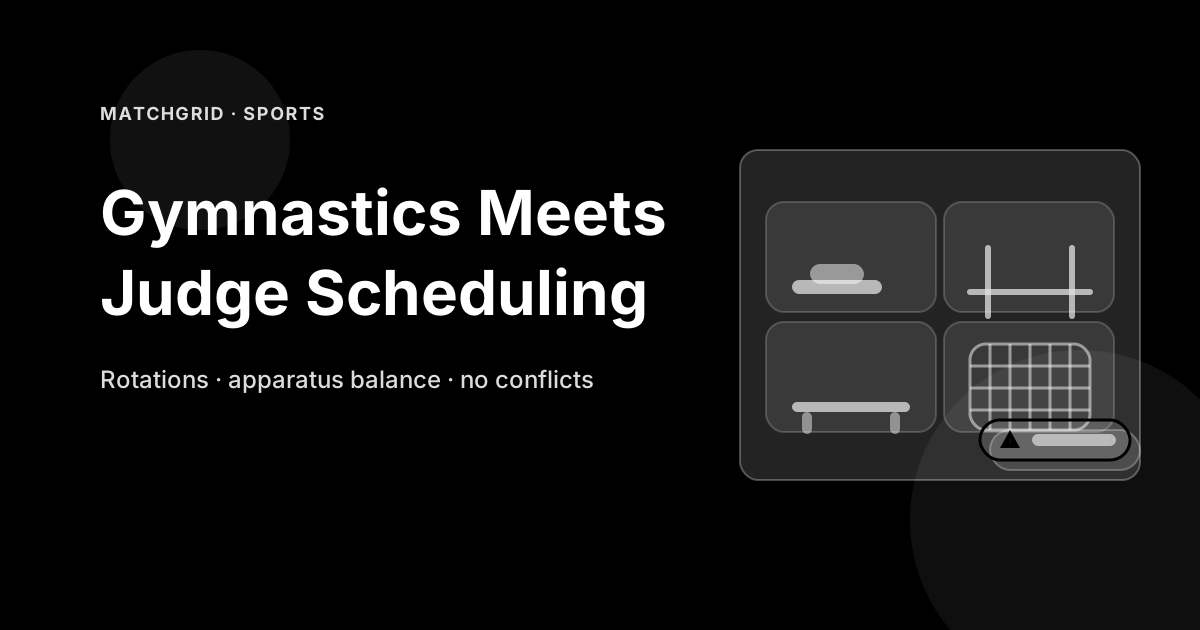
Gymnastics scheduling is the operational process of assigning rotations to apparatus and sessions while optimizing fairness, feasibility, and logistics. Gymnastics meets face unique constraint complexity: athletes rotate through 4 apparatus (vault, bars, beam, floor), each apparatus requires dedicated judges, and multi-day championships must balance competition flow across sessions. Effective gymnastics scheduling requires rotation generation, judge allocation logic, and session balancing that manual methods cannot provide.
Meet directors managing high school or club gymnastics championships confront a scheduling challenge unique to rotation-based sports: 80 gymnasts competing across 4 apparatus over 2 days require 320 routines scheduled across multiple sessions with 12-16 judges allocated without conflicts.
What makes gymnastics scheduling complex
Gymnastics scheduling complexity originates from rotation structures and judge requirements:
Rotation generation: Gymnasts are organized into squads (groups of 4-6 athletes). Squads rotate through apparatus in a fixed sequence (e.g., Squad A: Vault → Bars → Beam → Floor). Generating rotation schedules that balance athlete counts across apparatus and minimize wait times requires algorithmic logic.
Judge allocation constraints: Each apparatus requires 2-4 judges (vault: 2, bars: 2-4, beam: 2-4, floor: 2-4). Judges cannot work consecutive sessions without rest. Allocating 12-16 judges across apparatus and sessions without creating conflicts requires constraint optimization.
Multi-day session balancing: Championship meets span 2-3 days with morning and evening sessions. Balancing athlete counts across sessions, ensuring fair start times (no squad always competes last), and coordinating judge availability across days creates layered scheduling constraints.
Schedule gymnastics correctly Build fair, conflict-free schedules using MatchGrid’s constraint engine. Gymnastics scheduling software
The real-world constraints behind rotation management and judge allocation
Rotation constraints reflect competitive fairness and operational logistics:
Apparatus transition timing: Squads need 5-7 minutes to transition between apparatus (chalk hands, adjust equipment, warmup). Scheduling transitions too tightly creates delays. Scheduling transitions too loosely extends meet duration beyond acceptable limits (3-4 hours per session).
Judge fatigue management: Judges cannot work 3+ consecutive hours without rest. Allocating judges to back-to-back sessions creates fatigue, scoring inconsistency, and safety concerns. Rest requirements between sessions must be enforced.
Warmup coordination: Athletes need apparatus-specific warmup (touch warmup on bars, beam, vault runway practice). Coordinating warmup schedules with competition rotations prevents conflicts between warmup and active competition.
A gymnastics meet scheduler must generate rotation structures, allocate judges with rest enforcement, and coordinate warmup logistics automatically.
How scheduling breaks when done manually
Manual gymnastics meet scheduling collapses predictably:
Rotation imbalance: Manual squad assignments create unbalanced rotations. Vault has 8 squads waiting while bars has 2 squads. Athletes wait 45 minutes between apparatus. Meet duration extends to 5+ hours. Gymnasts fatigue. Performance suffers.
Judge allocation conflicts: Judges are scheduled for overlapping apparatus or consecutive sessions without rest. Judge availability collapses mid-meet. Event directors scramble to find replacement judges. Scoring delays create cascading session delays.
Session time overruns: Without optimization, sessions extend beyond scheduled end times. Evening sessions start late. Athletes warm up at 9 PM. Competitive performance degrades due to fatigue and schedule chaos.
A constraint-based scheduling method that works
Effective gymnastics meet scheduling follows structured logic:
1. Generate squad rotations: Assign athletes to squads. Generate rotation sequences ensuring balanced apparatus utilization (each apparatus has similar squad counts per rotation).
2. Encode judge allocation constraints: Model judge availability, apparatus requirements (vault needs 2 judges, bars needs 4), and rest requirements (minimum 2 hours between sessions).
3. Allocate judges with conflict prevention: Use constraint propagation to assign judges to apparatus and sessions while enforcing rest windows and availability constraints.
4. Balance multi-day sessions: Distribute squads across days and sessions to balance athlete counts, ensure fair start time distribution (no squad always starts on vault), and complete sessions within time limits.
Modern gymnastics meet scheduling platforms automate rotation generation, judge allocation, and session balancing, reducing 12+ hours of manual work to 15 minutes of setup plus 2 minutes of generation.
Schedule gymnastics correctly Build fair, conflict-free schedules using MatchGrid’s constraint engine. Gymnastics scheduling software
Checklist: What to collect before scheduling
Before generating a gymnastics meet schedule, collect:
- Athlete entries by level: Which gymnasts compete in which levels (Level 4, Level 7, Level 10, etc.)
- Squad sizes: Target athletes per squad (typically 4-6 gymnasts)
- Session structure: Number of days, sessions per day, start/end times
- Apparatus requirements: Equipment availability, apparatus rotation sequences
- Judge pool: Available judges, apparatus certifications (bars-certified, beam-certified)
- Judge rest requirements: Minimum hours between judging sessions (typically 2-3 hours)
- Warmup logistics: Warmup duration per apparatus, warmup/competition coordination
- Awards timing: Medal ceremony schedules, session breaks
Incomplete judge availability data creates mid-meet allocation failures and scoring delays.
How modern scheduling engines handle this
Constraint-based scheduling engines for gymnastics operate in phases:
Phase 1: Squad generation and rotation assignment: Organize athletes into squads. Generate rotation sequences balancing apparatus utilization and minimizing wait times.
Phase 2: Judge constraint modeling: Encode judge availability, apparatus certification requirements, and rest windows as a constraint satisfaction problem (CSP).
Phase 3: Judge allocation with conflict prevention: Assign judges to apparatus and sessions using constraint propagation. Reject assignments that violate rest requirements or create overlaps.
Phase 4: Session balancing optimization: Distribute squads across sessions to balance athlete counts, ensure fair rotation start times, and complete sessions within time limits.
Phase 5: Real-time adjustment support: Handle judge withdrawals or athlete scratches with instant regeneration. Rebalance rotations and reallocate judges in under 60 seconds.
This approach scales to 200+ gymnast championships and eliminates judge conflicts.
Schedule gymnastics correctly Build fair, conflict-free schedules using MatchGrid’s constraint engine. Gymnastics scheduling software
FAQ
How many judges are needed for a 2-day meet? For a meet with 4 sessions and 4 apparatus, you need 12-16 judges minimum (2-4 judges per apparatus). More judges allow for rotation and rest.
Can judges work multiple sessions? Yes, but they need 2-3 hours rest between sessions. The system enforces rest requirements automatically and prevents back-to-back session assignments.
What if a judge withdraws the day of the meet? Remove the judge from availability and regenerate. The system reallocates judge assignments to remaining judges automatically.
How is squad rotation determined? Squads rotate through apparatus in fixed sequences (e.g., Olympic order: Vault → Bars → Beam → Floor). The system assigns squads to starting apparatus and generates full rotation schedules.
Does this work for men’s and women’s gymnastics? Yes. Men’s gymnastics uses 6 apparatus instead of 4. The constraint engine handles both formats with the same underlying rotation and judge allocation logic.
Conclusion
Gymnastics meet scheduling requires rotation generation, judge allocation optimization, and session balancing. Manual methods create rotation imbalances, judge allocation conflicts, and session overruns. Constraint-based engines generate balanced rotations, allocate judges with rest enforcement, and distribute squads fairly across sessions automatically. For meet directors managing multi-day championships, automation eliminates judge conflicts and ensures sessions complete on schedule.
Explore how MatchGrid’s constraint engine can transform your gymnastics meet operations.