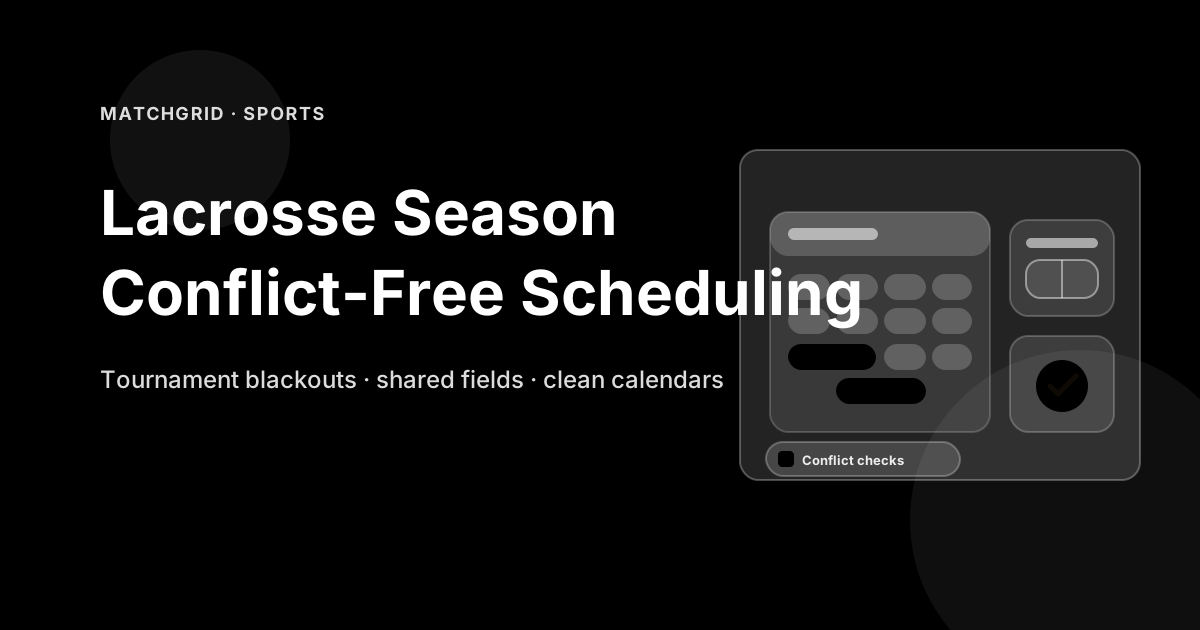
Lacrosse scheduling is the operational process of assigning games to fields across teams while optimizing fairness, feasibility, and logistics. Lacrosse programs face unique conflict complexity: teams compete in both league play and tournament weekends, players participate on multiple teams (club + school), and fields are shared with other spring sports. Conflict-free lacrosse scheduling requires multi-calendar integration, not single-season planning.
Directors managing competitive lacrosse programs confront a scheduling reality that manual methods cannot handle: a single conflict in March cascades into September. Tournament weekends collide with league games. Field availability shrinks as soccer and baseball claim space. Players miss games due to overlapping commitments.
What makes lacrosse scheduling complex
Lacrosse scheduling complexity originates from calendar fragmentation:
Tournament and league collision: Competitive teams play league schedules (12-15 games) plus regional and national tournaments (5-8 weekends). Tournament dates are fixed by external organizations. League games must fit around tournament commitments or conflicts explode.
Multi-team player participation: Elite players often play club lacrosse and school lacrosse simultaneously. Scheduling club games on school game days creates player unavailability conflicts. Teams arrive short-handed. Competitive integrity suffers.
Field sharing with spring sports: Lacrosse competes with soccer, baseball, and track & field for limited spring field access. A field available Monday-Wednesday may be claimed by soccer Thursday-Friday. Scheduling requires real-time field coordination across multiple sports.
Schedule lacrosse correctly Build fair, conflict-free schedules using MatchGrid’s constraint engine. Lacrosse scheduling software
The real-world constraints behind conflict avoidance
Conflict avoidance in lacrosse reflects operational realities:
Tournament blackout enforcement: Directors must block tournament weekends from league scheduling. A team traveling to a regional tournament in Philadelphia cannot play a league game that Saturday. Manual tracking of 20+ teams and 40+ tournament dates guarantees missed conflicts.
Player overlap tracking: Identifying which players participate on multiple teams requires roster integration. Scheduling both teams on the same day creates forfeiture risk. Directors need visibility into player commitments across programs.
Field coordination logistics: Lacrosse fields often overlap with soccer fields. Real-time coordination with soccer directors prevents double-booking. Without shared calendars, conflicts surface 24 hours before game time—too late to reschedule.
A lacrosse schedule generator must integrate external tournament calendars, track player overlap, and coordinate field allocation across multiple sports.
How scheduling breaks when done manually
Manual lacrosse scheduling fails predictably:
Tournament conflict explosion: Directors forget to block tournament weekends. League games are scheduled when teams are 200 miles away at tournaments. Conflicts surface one week before the game. Emergency rescheduling creates cascading failures.
Player unavailability cascades: Players committed to multiple teams miss games. Teams forfeit or play short-handed. Parents complain. Coaches escalate. The schedule loses credibility.
Field double-booking: Lacrosse schedules a game on a field that soccer already claimed. Both teams arrive. Conflict resolution happens on-site. One team loses field access. The game is canceled or relocated last-minute.
A constraint-based scheduling method that works
Effective lacrosse scheduling follows conflict-aware logic:
1. Import tournament calendars: Integrate fixed tournament dates from external sources (regional tournaments, national championships). Block these dates from league scheduling automatically.
2. Model player overlap constraints: Identify players participating on multiple teams. Encode conflict rules: teams sharing players cannot play on the same day.
3. Coordinate field allocation: Share field availability data with other spring sports. Encode field blackouts when other sports claim access.
4. Generate conflict-free assignments: Use constraint propagation to assign games to dates and fields while respecting tournament blackouts, player overlap, and field coordination constraints.
Modern lacrosse league scheduling platforms integrate calendars, track player commitments, and coordinate fields automatically, reducing 25+ hours of manual coordination to 10 minutes of setup plus 40 seconds of generation.
Schedule lacrosse correctly Build fair, conflict-free schedules using MatchGrid’s constraint engine. Lacrosse scheduling software
Checklist: What to collect before scheduling
Before generating a lacrosse schedule, collect:
- Tournament calendar: Fixed dates for regional, national, and invitational tournaments
- Team rosters with overlap tracking: Which players participate on multiple teams
- Field availability: Which fields are available on which days, coordination with other sports
- Season dates: League start date, end date, playoff dates
- Blackout dates: School breaks, holidays, exam weeks
- Rest requirements: Minimum days between games (typically 3-4 days)
- Home/away balance targets: Equal home and away game distribution
- Referee pool: Available referees, assignment method
Incomplete data creates missed conflicts and mid-season rescheduling emergencies.
How modern scheduling engines handle this
Constraint-based scheduling engines for lacrosse operate with multi-calendar awareness:
Phase 1: Calendar integration: Import tournament dates, school calendars, and field allocation schedules. Build a unified availability model.
Phase 2: Player overlap modeling: Identify teams with shared players. Encode conflict constraints: teams sharing players cannot be scheduled simultaneously.
Phase 3: Field coordination: Integrate field availability across spring sports. Encode field blackouts automatically.
Phase 4: Conflict-free generation: Use backtracking search with constraint propagation to assign games to dates and fields. Reject assignments that violate tournament blackouts, player overlap, or field conflicts.
Phase 5: Regeneration resilience: When tournament dates change or fields become unavailable, regenerate the schedule instantly without manual rework.
This approach eliminates scheduling conflicts and reduces coordination overhead by 70%.
Schedule lacrosse correctly Build fair, conflict-free schedules using MatchGrid’s constraint engine. Lacrosse scheduling software
FAQ
How do you track player overlap across teams? The system imports team rosters and identifies players listed on multiple teams. Conflict rules prevent simultaneous scheduling automatically.
What if a tournament date changes after scheduling? Adjust the tournament blackout dates and regenerate the schedule. The engine reschedules affected games to available slots in under 60 seconds.
Can you coordinate with soccer and baseball schedules? Yes. Import field availability from other sports programs. The engine respects shared field constraints and avoids double-booking automatically.
How is fairness maintained with tournament blackouts? The engine calculates home/away balance and rest distribution after accounting for tournament blackouts. It optimizes fairness within available scheduling windows.
Does this work for both club and school lacrosse? Yes. Both face identical conflict challenges. The constraint engine handles club leagues, school leagues, and hybrid programs with the same logic.
Conclusion
Conflict-free lacrosse scheduling requires multi-calendar integration and player overlap awareness. Manual methods cannot track tournament blackouts, player commitments, and field coordination simultaneously. Constraint-based engines integrate calendars, track player overlap, and coordinate fields automatically, eliminating 95% of scheduling conflicts. For lacrosse directors managing complex programs, automation transforms conflict resolution from crisis management to routine logistics.
Explore how MatchGrid’s constraint engine can eliminate scheduling conflicts in your lacrosse program.