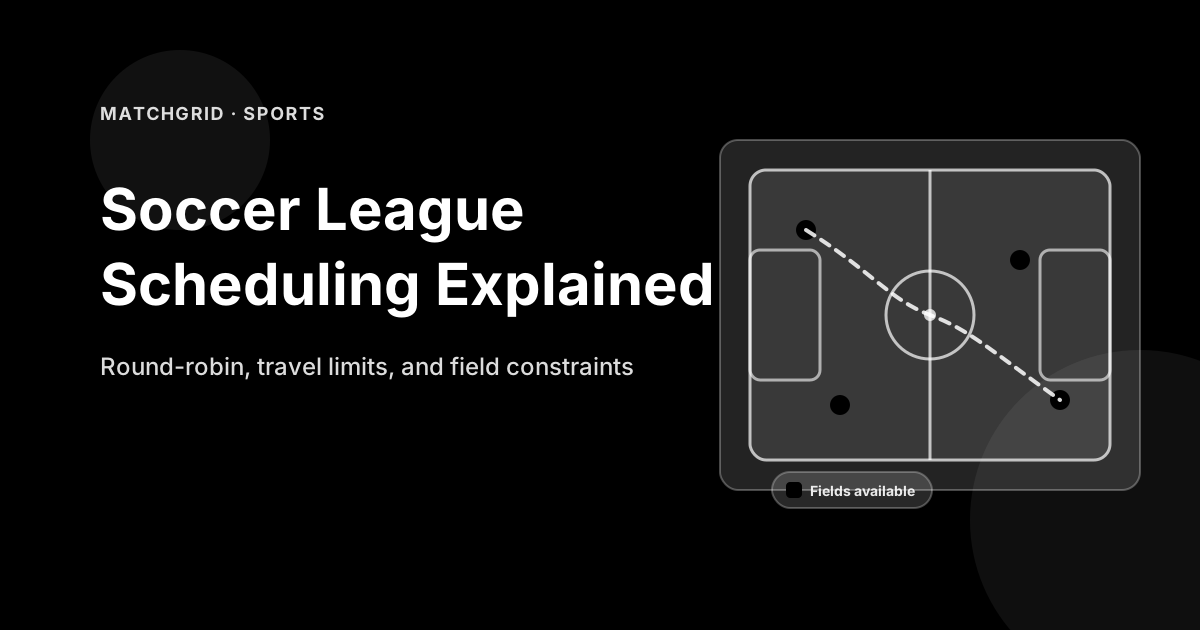
Soccer scheduling is the operational process of assigning matches to fields across divisions while optimizing fairness, feasibility, and logistics. Soccer leagues face unique constraint complexity: field availability is constrained by weather and maintenance windows, travel distances span large geographic areas, and round-robin structures must balance home/away equity across 10-20 match days.
League directors managing regional soccer programs confront a scheduling challenge that spreadsheets cannot solve: balancing competitive fairness with operational feasibility across dozens of teams, limited fields, and unpredictable weather.
What makes soccer scheduling complex
Soccer scheduling complexity originates from three operational realities:
Field availability constraints: Outdoor fields depend on weather and field conditions. Wet fields close for safety. Maintenance windows remove fields from availability. A league with access to 8 fields may effectively have 5-6 usable fields on any given weekend.
Travel limit optimization: Soccer leagues often span 50-100 mile regions. Sending teams on 90-minute drives repeatedly creates equity complaints. Travel clustering (scheduling consecutive away games in the same region) reduces total travel but complicates constraint satisfaction.
Round-robin fairness requirements: Competitive soccer leagues use round-robin formats where every team plays every other team. With 16 teams, that’s 120 matches. Ensuring each team plays home/away against every opponent while respecting travel and field constraints requires constraint optimization, not calendar management.
Schedule soccer correctly Build fair, conflict-free schedules using MatchGrid’s constraint engine. Soccer scheduling software
The real-world constraints behind travel limits and round-robin structures
Travel limits in soccer reflect practical operational constraints:
Youth player travel: Parents transport players. Weekend matches tolerate 45-60 minute drives. Weeknight training sessions enforce 20-30 minute limits. Scheduling must respect parent availability and player fatigue.
Geographic clustering: Teams in the same county or region should play nearby opponents more frequently. Long-distance rivalry matches are acceptable 2-3 times per season, not every week.
Round-robin integrity: True competitive fairness requires every team plays every other team at home and away. Partial round-robins (play each team once) reduce match count but sacrifice fairness. Full round-robins (play each team twice) double the schedule complexity.
A soccer schedule generator must balance round-robin completeness with travel feasibility.
How scheduling breaks when done manually
Manual soccer scheduling fails predictably:
Travel imbalance: Without automated travel tracking, some teams accumulate 800 miles of total travel while others drive 300 miles. Complaints escalate. Parents threaten to withdraw.
Field allocation failure: Manual field assignment creates conflicts. Double-booking fields, scheduling matches on closed fields, and missing maintenance windows all occur frequently. Mid-season corrections become impossible.
Round-robin incompleteness: Attempting to manually balance home/away matchups across 16 teams and 120 matches guarantees errors. Some teams play opponents twice at home, once away. Competitive integrity collapses.
A constraint-based scheduling method that works
Effective soccer scheduling follows structured logic:
1. Generate round-robin matchups: Create all required home/away pairings before assigning dates. Validate structural completeness (every team plays every opponent).
2. Encode field and travel constraints: Model field availability, travel distance limits, and rest requirements as logical constraints.
3. Assign matches to dates with constraint propagation: Use backtracking search to allocate matches to field slots while enforcing travel limits and field capacity. Prune infeasible assignments early.
4. Optimize travel clustering: Identify geographic clusters. Schedule consecutive away matches in the same region to minimize total travel distance.
Modern soccer league scheduling platforms execute this logic automatically, reducing 30+ hours of manual scheduling to 15 minutes of setup plus 45 seconds of generation.
Schedule soccer correctly Build fair, conflict-free schedules using MatchGrid’s constraint engine. Soccer scheduling software
Checklist: What to collect before scheduling
Before generating a soccer league schedule, collect:
- Team roster: Team names, division assignments, home field preferences
- Field availability: Which fields are available on which days, maintenance schedules
- Season dates: Start date, end date, weather-related blackouts, holiday weekends
- Travel constraints: Maximum travel distance/time, geographic clustering preferences
- Round-robin requirements: Single round-robin (play once) or double (play home and away)
- Match duration: Game length plus warmup and cleanup time
- Referee assignments: Self-refereeing or assigned referee pool
- Weather contingency: Backup fields, rescheduling policy for rainouts
Incomplete data creates infeasible schedules or forces mid-season manual corrections.
How modern scheduling engines handle this
Constraint-based scheduling engines for soccer operate in phases:
Phase 1: Matchup generation: Create round-robin pairings. Validate completeness (every team plays every opponent according to format).
Phase 2: Constraint encoding: Model field capacity, travel limits, rest requirements, and weather contingencies as a constraint satisfaction problem (CSP).
Phase 3: Assignment with backtracking: Assign matches to fields and dates using constraint propagation. Reject infeasible branches early. Generate schedules that satisfy all hard constraints.
Phase 4: Travel optimization: Calculate total travel distance per team. Use local search to swap assignments and reduce travel variance while maintaining constraint satisfaction.
Phase 5: Weather resilience: Build schedules with slack capacity (backup dates, alternative fields). Support instant regeneration when fields close due to weather.
This approach scales to 50+ teams and handles real-world complexity manual methods cannot.
Schedule soccer correctly Build fair, conflict-free schedules using MatchGrid’s constraint engine. Soccer scheduling software
FAQ
How do you handle rainouts and field closures? Build backup dates into the season structure. When a field closes, the engine regenerates affected matches to available slots automatically. No manual rework required.
Can you optimize for travel clustering? Yes. The engine identifies geographic clusters and schedules consecutive away matches in the same region, reducing total travel by 20-30%.
What if we don’t have enough fields? The system will report infeasible constraints. You can extend the season, add fields, reduce match frequency, or adjust rest requirements and regenerate.
How is round-robin fairness validated? The engine generates a matchup matrix showing every team pairing. You can verify every team plays every opponent the correct number of times before finalizing.
Does this work for tournaments? Yes. Tournaments use pool play or bracket structures instead of round-robin. The constraint engine handles both league and tournament formats.
Conclusion
Soccer league scheduling requires round-robin structural integrity, travel optimization, and field capacity management. Manual methods collapse under constraint complexity. Constraint-based engines generate fair, travel-optimized schedules in minutes and regenerate instantly when weather or field availability changes. For league directors managing regional soccer programs, automation transforms operational chaos into predictable logistics.
Explore how MatchGrid’s constraint engine can optimize your soccer league scheduling operations.