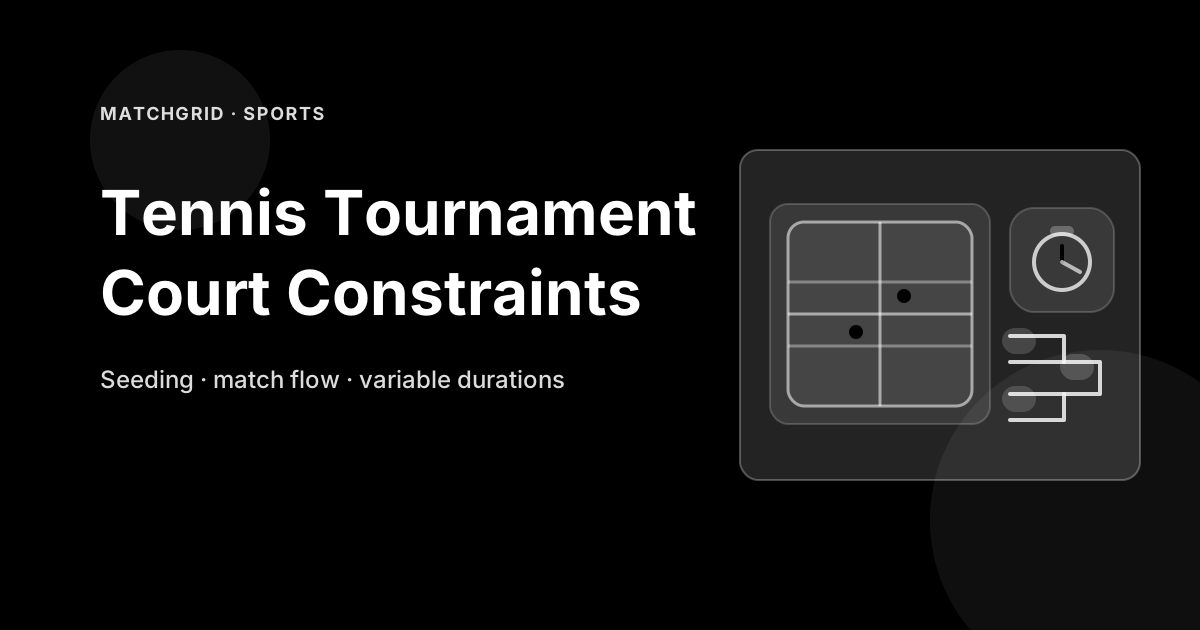
Tennis scheduling is the operational process of assigning matches to courts across draws while optimizing fairness, feasibility, and logistics. Tennis tournaments face unique court constraint complexity: matches vary wildly in duration (45 minutes to 4+ hours), bracket progression requires losers to be eliminated while winners advance, and multi-day championships must balance featured matches on show courts with efficient utilization of back courts. Effective tennis tournament scheduling requires bracket generation, court allocation logic, and match flow optimization that manual methods cannot provide.
Tournament directors managing competitive tennis events confront a scheduling challenge unique to elimination-based individual sports: 64 players in singles plus 32 teams in doubles require 100+ matches scheduled across 8 courts over 3 days with proper seeding, featured match timing, and completion before darkness.
What makes tennis tournament scheduling complex
Tennis tournament complexity stems from match duration unpredictability and court hierarchy:
Match duration unpredictability: Tennis matches lack fixed durations. A first-round match may last 45 minutes (6-0, 6-1) or 4 hours (7-6, 6-7, 7-6). Scheduling subsequent matches requires buffer time and backup plans. Manual schedules that assume fixed durations create cascading delays or idle courts.
Court hierarchy and featured match allocation: Tournaments designate show courts (center court, court 1) for featured matches (top seeds, finals) and back courts for early rounds. Allocating matches to appropriate court tiers while maximizing all court utilization requires optimization logic.
Bracket progression and rest requirements: Winners advance through rounds, losers are eliminated. Players need 24-48 hours rest between matches for recovery. Scheduling quarterfinals, semifinals, and finals to provide adequate rest while completing the tournament on schedule requires constraint optimization.
Schedule tennis correctly Build fair, conflict-free schedules using MatchGrid’s constraint engine. Tennis scheduling software
The real-world constraints behind court allocation and bracket seeding
Court allocation constraints reflect competitive fairness and operational realities:
Seeding and bracket placement: Top players are seeded to avoid meeting until later rounds. #1 seed should meet #2 seed in finals, not round 1. Proper seeding requires algorithmic bracket placement (power-of-2 brackets with systematic seed distribution).
Rest window enforcement: Players cannot play matches on consecutive days in best-of-3 or best-of-5 formats. Scheduling round of 16 on Monday, quarterfinals on Tuesday, and semifinals on Wednesday violates rest requirements. Player performance degrades. Injury risk increases.
Weather contingencies and indoor backup: Outdoor tournaments face rain delays. Backup indoor courts or rain date scheduling prevents tournament cancellation. Scheduling must include contingency plans for weather-related disruptions.
A tennis tournament scheduler must generate seeded brackets, allocate matches to courts by priority, enforce rest windows, and handle weather contingencies automatically.
How scheduling breaks when done manually
Manual tennis tournament scheduling collapses predictably:
Seeding errors: Manual bracket placement puts #1 and #2 seeds in the same half of the draw. They meet in semifinals instead of finals. Competitive integrity collapses. Players and sponsors complain.
Court allocation failures: Show courts sit idle while back courts are overloaded. Featured matches (top seed finals) are assigned to back court while lesser matches occupy center court. Spectator experience degrades. Sponsorship value declines.
Rest violations: Players are scheduled for quarterfinals Sunday and semifinals Monday. Insufficient rest violates tournament rules and player safety protocols. Players withdraw. Brackets are disrupted.
A constraint-based scheduling method that works
Effective tennis tournament scheduling follows bracket-aware logic:
1. Generate seeded brackets: Create bracket structures (16-draw, 32-draw, 64-draw). Apply seeding algorithms (#1 seed position 1, #2 seed position 32 in 32-draw). Distribute remaining seeds systematically.
2. Allocate matches to courts by priority: Assign finals and semifinals to show courts. Assign early rounds to back courts. Balance court utilization to minimize idle time while respecting court hierarchy.
3. Enforce rest requirements: Schedule rounds with 24-48 hour gaps between matches for players advancing. Validate bracket progression completes within tournament window.
4. Optimize match sequencing: Sequence matches on each court to minimize idle time. Use match duration estimates plus buffers to create realistic schedules. Adjust dynamically as actual match durations vary.
Modern tennis tournament scheduling platforms automate bracket generation, court allocation, and match sequencing, reducing 10+ hours of manual work to 15 minutes of setup plus 2 minutes of generation.
Schedule tennis correctly Build fair, conflict-free schedules using MatchGrid’s constraint engine. Tennis scheduling software
Checklist: What to collect before scheduling
Before generating a tennis tournament schedule, collect:
- Player entries: Singles and doubles entries, player rankings or ratings
- Seeding decisions: Which players receive seeds (top 8 for 32-draw, top 16 for 64-draw)
- Tournament format: Single elimination, consolation draws, round-robin groups
- Court availability: Number of courts, show court vs back court designations, daily hours
- Match format: Best-of-3 sets, best-of-5 sets (finals only or all rounds)
- Rest requirements: Minimum days between matches (typically 1-2 days)
- Tournament duration: Start date, end date, daily start/end times
- Weather contingency: Indoor backup courts, rain date schedules
Incomplete seeding data creates bracket errors and competitive integrity failures.
How modern scheduling engines handle this
Constraint-based scheduling engines for tennis tournaments operate with bracket awareness:
Phase 1: Bracket generation with seeding: Generate bracket structures. Apply seeding algorithms ensuring top seeds are separated properly (#1 and #2 seeds in opposite halves).
Phase 2: Court tier allocation: Assign matches to courts by priority. Finals on show courts, early rounds on back courts. Balance court utilization.
Phase 3: Rest window enforcement: Validate players advancing through rounds receive adequate rest. Schedule rounds with 24-48 hour gaps.
Phase 4: Match sequencing optimization: Sequence matches on each court using duration estimates and buffers. Minimize idle court time while accounting for unpredictability.
Phase 5: Dynamic rescheduling: Support real-time match rescheduling when actual durations differ from estimates. Regenerate remaining matches to keep tournament on schedule.
Phase 6: Weather contingency handling: Build rain date schedules and indoor backup plans. Support instant regeneration when weather disrupts outdoor play.
This approach scales to 128-draw Grand Slam tournaments across multiple days.
Schedule tennis correctly Build fair, conflict-free schedules using MatchGrid’s constraint engine. Tennis scheduling software
FAQ
How is bracket seeding determined? Seeding uses player rankings or tournament committee decisions. Top seeds (1-8 for 32-draw, 1-16 for 64-draw) are placed systematically to prevent early-round matchups. The system applies standard seeding algorithms automatically.
Can matches be rescheduled mid-tournament? Yes. Adjust match times or court assignments and regenerate. The system updates all subsequent matches while preserving bracket structure and rest requirements.
What if a player withdraws? Remove the player and award their opponent a walkover. The system advances the opponent automatically and adjusts the bracket accordingly.
How many courts are needed for a 64-draw tournament? For a 3-day tournament with best-of-3 sets, you need 6-8 courts minimum to complete 63 matches while providing adequate rest between rounds.
Does this work for both singles and doubles? Yes. Singles and doubles use separate brackets but share courts. The system coordinates court allocation across both draws automatically.
Conclusion
Tennis tournament scheduling requires seeded bracket generation, court tier allocation, rest window enforcement, and match flow optimization. Manual methods create seeding errors, court allocation failures, and rest violations. Constraint-based engines generate seeded brackets automatically, allocate matches to courts by priority, enforce rest requirements, and optimize match sequencing to complete tournaments on schedule. For tournament directors managing competitive tennis events, automation transforms 10 hours of manual bracket generation into predictable, equitable championships.
Explore how MatchGrid’s constraint engine can optimize your tennis tournament scheduling operations.